
Peel Testing Grips and Fixtures
Written by Chris Thomas, Universal Grip Company · Reviewed by Frank Bertini · Updated October 17, 2026
A peel test fixture holds one side of a bonded, taped or laminated assembly and controls the angle at which the other side is pulled away, so that a universal testing machine or tensile tester can record the force needed to separate the bond per unit width. The angle is the whole point: peel strength changes with angle and rate, so every peel standard fixes both, and the fixture is what makes the angle repeatable from specimen to specimen and from lab to lab. Universal Grip builds 90° sliding-table fixtures, 180° fixtures, floating-roller and climbing-drum fixtures, roll-unwind and card-peel fixtures, and the vise, pneumatic and wedge grips used for T-peel, all in adapters that mount to any machine brand.
This page explains which fixture each peel method needs, how to choose between them, what each of our fixtures does, which standards they serve, how they mount to your machine, and the setup details that decide whether a peel result is valid. For the methods themselves (specimen sizes, speeds, calculations), our standard-by-standard guides to ASTM D903, ASTM D1876, ASTM D3330, ASTM D3167, ASTM D1781 and ASTM D6862 go deeper, and the peel test fixtures guide walks through each geometry on a Mark-10 frame.
In this guide: What a Peel Test Fixture Does · How to Choose a Peel Fixture · Our Peel Fixtures and Grips · Peel Standards and the Fixture Each One Needs · Mounting and Machine Compatibility · Setting Up a Valid Peel Test · Common Mistakes · Related Equipment · FAQ
What a Peel Test Fixture Does
In a tensile test the machine pulls along one axis; in a peel test the force that matters is applied at an angle to the bond line, and that angle has to be held constant while the peel front moves along the specimen. A plain pair of grips can only do that for one geometry, the T-peel, where both adherends are flexible and fold back on themselves. Every other peel method needs a fixture: a plate or table that holds the rigid or backed member, and a mechanism (a sliding stage, a roller, a drum, a mandrel) that keeps the angle at 90°, 180°, a roller-defined angle, or a drum radius as the peel progresses.
The number a peel test produces is a force per unit width (N/mm, N/25 mm, kN/m or lbf/in), averaged over a defined length of peel, and it is a comparative value rather than a design property. That makes consistency the only thing the fixture is for. The questions that decide which fixture you need are: is one adherend rigid or both flexible; what angle does the standard call for; is the bond a tape, a laminate, a coating, a structural adhesive or a sandwich-panel skin; and how much of the bond length must be peeled. The peel testing applications page compares the methods by material; the sections below compare them by fixture.
Peel fixtures are used by adhesive and tape manufacturers (D3330, D903, D1876), packaging and label converters (F88 seal strength, D3330, peelable lids), aerospace and composite shops (D1781 climbing drum, D3167 floating roller), automotive trim and coated-fabric suppliers (D751, D903), card and electronics makers (ISO 10373 card lamination peel) and any quality lab that has to prove a bond meets a specification.
How to Choose a Peel Fixture
Start from the standard if you have one; the fixture is defined by the method, not by the material. If you are choosing a method, use the adherend stiffness and the angle it implies:
-
Both members flexible (foils, films, fabrics, bonded thin metal): T-peel per ASTM D1876. No fixture is needed; a pair of vise grips, pneumatic grips or wedge grips holds the two bent-back legs.
-
One member rigid, flexible member can fold back on itself (tapes, labels, thin laminates on panels): 180° peel per ASTM D3330 Method A or ASTM D903. A 180° fixture holds the panel flat and in line with the load axis while the flexible member is pulled back over it.
-
One member rigid, flexible member too stiff to fold 180° (coated fabrics, thicker films, foam tapes, rubber on metal): 90° peel per ASTM D6862, D3330 Method F or D903. The 90° fixture uses a sliding table that moves with the crosshead so the peel front stays directly under the load axis.
-
Structural film or paste adhesive between a thin flexible skin and a rigid adherend (aerospace bonded panels): floating-roller peel per ASTM D3167. The flexible member is drawn over a roller that fixes the peel angle and radius.
-
Skin peeled from a honeycomb or foam sandwich core: climbing-drum peel per ASTM D1781. The skin wraps onto a drum that climbs the specimen as the machine pulls, with the drum radius setting the peel moment.
-
Tape peeled from its own roll (unwind force): ASTM D3811 or DIN 53357 roll-unwind fixture, with the roll on a free-spinning mandrel.
-
Laminated card layers (ID and payment cards): ISO 10373 card peel fixture.
-
Heat seals in flexible packaging: ASTM F88 seal strength, which is run with grips as an unsupported or supported T-peel of the seal, not with a peel fixture.
Two more decisions follow the geometry. Capacity: peel loads are small, usually a few newtons for tapes and labels up to a few hundred newtons for structural bonds, so the load cell matters more than the frame; the fixture itself is rated far above any peel load. Machine: a Mark-10 tensile tester covers tapes, labels, packaging and most coated fabrics; structural adhesive and sandwich-panel peel usually runs on a benchtop universal testing machine with the longer travel that a 150 mm bond at a 2:1 crosshead ratio needs.
Our Peel Fixtures and Grips
90° Peel Fixture (sliding table)
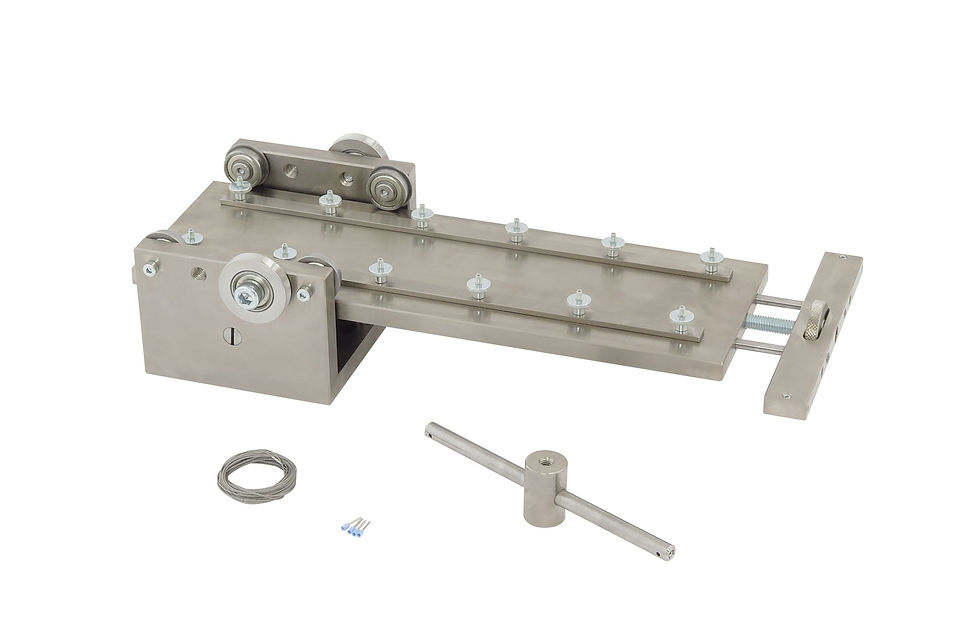
The 90° fixture is called for in several standards including ASTM D3330 Method F, ASTM D903 when the second member is rigid and stiff, and ASTM D6862. Ours uses a spring-loaded sliding table to hold the peel angle at 90° through the whole test: as the crosshead rises and the peel front advances, the table translates horizontally so the point of separation stays under the load axis. A small series of cables and pulleys pulls the stage, and they are mounted behind the load cell so the force of moving the table never enters the peel strength measurement. The flexible member is held in the upper grip; the panel or backing clamps to the table.
180° Peel Fixture
The 180° peel procedure measures the maximum peel strength of a tape or bond: tapes have the most gripping force when peeled back on themselves at 180°, which is why D3330 Method A and the 180° form of D903 are the most common adhesion tests in tape and label specifications. The fixture holds the test panel flat and parallel to the load axis so the folded-back tape runs straight up to the upper grip; a 180° test needs 305 mm/min of crosshead speed to produce the 152 mm/min separation rate D903 specifies, so check the frame's speed range as well as its travel.
ASTM D3167 Floating Roller Peel Fixture
The floating roller peel fixture is used for ASTM D3167. The substrate board is mounted with the tape or bonded skin facing down, and the flexible member is pulled through the centre roller at roughly 90°; the roller defines both the angle and the bend radius of the peel, which is what makes D3167 so repeatable for structural film adhesives. Other angles are also available, including the geometries called for in DIN 53289, EN 1464 and ISO 4578.
ASTM D1781 Climbing Drum Peel Fixture
The climbing drum peel fixture tests the adhesives that bond skins to sandwich-core composite structures per ASTM D1781; it can also be used for tapes, though that is less common. The drum mounts as the bottom grip and a vise grip is used as the top grip to pull the substrate vertically; as the crosshead rises, the drum rolls up the specimen and the skin wraps onto it, so the peel torque comes from the drum radius and the measured load includes the drum's own climbing resistance, which is subtracted in the calculation.
ASTM D3811 Roll Unwind Fixture
This fixture measures the peel (unwind) force of an entire roll of tape per ASTM D3811. The roll is mounted on a spinning mandrel drum and the free end of the tape is pulled from the top grip, so the force recorded is the adhesion of the tape to its own backing. Standard rolls have a 3-inch inner core; designs for other core sizes, including those used in DIN 53357, are also available.
ISO 10373 Card Peel Fixture
The ISO 10373 fixture tests the peel strength of layers and features on credit, debit and identification cards. Cards use stickers and adhesives for logos, PIN labels and the signature panel on the back, and the lamination itself is a bonded assembly; the fixture holds the card so that a strip can be peeled at the angle the test method calls for.
Vise, Pneumatic and Wedge Grips for T-Peel
Vise grips are the most popular general-purpose tensile grip and are used in adhesive testing to clamp the free end of a tape or the leg of a specimen and pull it. The T-peel test of ASTM D1876 needs only two tensile grips, one on each bent-back adherend; in some cases wedge grips are used for stiffer adherends. Pneumatic grips are used often because a constant air pressure standardizes the clamping force between technicians and holds thin legs without the force relaxing as the specimen thins; roller grips suit films and foils that tear at a jaw edge.
Variable Motorized 90° Peel System
For labs that need a 90° peel result without a full universal testing machine, the economical variable motorized 90° peel system pairs a motorized drive with the sliding-table geometry, so the peel angle is still held at 90° throughout the test. Ask for the cut sheet for capacity and speed options.
Peel Standards and the Fixture Each One Needs
-
ASTM D903 – 180° peel of a flexible member from a flexible or rigid member; 305 mm/min crosshead (152 mm/min separation); 180° fixture, or 90° fixture where the standard allows.
-
ASTM D1876 – T-peel of two flexible adherends; 254 mm/min; tensile grips only.
-
ASTM D3330 – pressure-sensitive tape: Methods A–E at 180° on a stainless panel, Method F at 90°; 305 mm/min; 180° or 90° fixture.
-
ASTM D6862 – 90° peel of flexible-to-rigid bonds; 254 mm/min; 90° sliding-table fixture.
-
ASTM D3167 – floating-roller peel of structural adhesives; 152 mm/min; floating roller fixture.
-
ASTM D1781 – climbing-drum peel of sandwich skins; climbing drum fixture plus a vise grip.
-
ASTM D3811 / DIN 53357 – unwind force of a tape roll; roll-unwind mandrel fixture.
-
ASTM D751 – coated-fabric coating adhesion; 180° peel in grips or on a 180° fixture.
-
ASTM F88 – seal strength of flexible barrier materials; grips (unsupported, 90° supported or 180° supported).
-
ASTM F2824 – mechanical seal strength of peelable lids on round containers; pinch grip with a 90° peel fixture.
-
ASTM D5458 – peel cling of stretch wrap film; inclined-plane cling fixture, not a peel fixture.
-
ISO 8510-1/-2, ISO 11339, EN 1464, DIN 53289, ISO 4578, ISO 10373 – the ISO and European equivalents, run on the same 90°, 180°, T-peel, floating-roller and card fixtures at their own speeds.
Results from different methods are not interchangeable: a 180° value, a 90° value and a T-peel value for the same adhesive differ because the adherends' bending energy is part of the measured load. Report the standard, the angle and the rate with every result.
Mounting and Machine Compatibility
Every Universal Grip peel fixture is supplied with the adapter that matches your machine's load string, whether it is a clevis pin, a threaded stud or a bayonet coupling, so the fixture bolts straight onto an Instron, MTS, ZwickRoell, Shimadzu, Tinius Olsen, ADMET, Galdabini or Mark-10 frame. Tell us the machine make, model and capacity when you ask for a quote and we size the adapter and the fixture rating together. On the Mark-10 testers, peel fixtures mount to the base plate and the upper grip to the force gauge; on benchtop universal testing machines the fixture mounts to the lower crosshead or base and the upper grip to the load cell.
Two frame checks before buying: travel (a 180° peel of a 152 mm bond needs more than 300 mm of crosshead movement; T-peel of a 241 mm bond needs around 500 mm) and speed (305 mm/min for D903 and D3330, 254 mm/min for D1876 and D6862, 152 mm/min for D3167). A low-capacity load cell (50 N to 500 N for most tapes, labels and fabrics; 1 to 2 kN for structural bonds) keeps the peel load in the accurate part of the range; our force gauges and interchangeable load cells cover the span.
Setting Up a Valid Peel Test
-
Align the bond line with the load axis. On a 180° or 90° fixture, the panel must be parallel to the crosshead travel and the peel front centred under the upper grip; a skewed panel peels from one edge first and gives a sawtooth trace.
-
Keep the flexible member straight and free. It must not touch the fixture, the panel edge or itself; rubbing adds friction that reads as peel strength.
-
Hand-start the peel. Separate the first 25 mm or so by hand so the peel front is established before the crosshead moves, then zero the load with the specimen slack so tare is removed.
-
Set the crosshead speed, not the separation rate. In 180° and T-peel geometries the bond separates at half the crosshead speed, which is why D903 specifies 305 mm/min to get 152 mm/min.
-
Average the plateau, not the peak. Standards call for the average load over a defined length of peel after the initial spike; set the software's averaging window accordingly and record maximum and minimum as well.
-
Record the failure mode. Adhesive, cohesive, substrate or mixed failure is a required report item and the quickest diagnostic when results scatter.
-
Condition as the standard says. D903 and D1876 require 7 days at 23 ± 1 °C and 50 ± 2 % RH unless the adhesive maker says otherwise; D3330 uses a dwell after a 2 kg roller application. For hot or cold peel, condition and test inside an environmental chamber.
Common Mistakes
-
Running a 90° test with plain grips and letting the angle drift toward 180° as the specimen lengthens; the sliding table exists to stop this.
-
Entering 152 mm/min as the crosshead speed for D903 (half the specified rate).
-
A load cell so large that a 5 N tape peel sits below 1 % of range.
-
Reporting peak load rather than the averaged plateau, or averaging through the start spike.
-
Comparing 180°, 90° and T-peel values as if they were the same property.
-
Mixing specimen widths without dividing by the measured width.
-
Skipping conditioning, or testing minutes after removing a specimen from the chamber.
-
Using a roll-unwind result (D3811) as if it were a surface adhesion result (D3330).
Related Equipment
-
Grips: vise grips, pneumatic grips, roller grips, wedge grips and pinch grips for lids and small peel tabs.
-
Machines: Mark-10 tensile testers from 100 lb for tapes and labels, benchtop universal testing machines for structural and sandwich-panel peel, and the manual force tester for quick 180° checks.
-
Specimen preparation: cutting dies and a die press for 25 mm strips, and a 2 kg roller for tape application.
-
Environment: environmental chambers for peel at service temperature.
-
Guides: the adhesives and tape testing page, the peel testing applications page and the peel fixtures article.
Peel Test Fixture FAQ
What is a peel test fixture?
A fixture that holds one side of a bonded or taped assembly and keeps the peel angle constant (90°, 180°, a roller angle or a drum radius) while a testing machine pulls the other side, so peel strength can be measured per unit width in a repeatable way.
Do I need a fixture for a T-peel test?
No. ASTM D1876 T-peel uses two flexible adherends bent apart into a T and pulled with ordinary tensile grips; vise, pneumatic or wedge grips are enough. Fixtures are needed when one member is rigid or the angle must be held at 90°, 180°, over a roller or on a drum.
What is the difference between a 90° and a 180° peel fixture?
A 180° fixture holds the panel in line with the load axis while the flexible member is folded back over itself; it gives the highest adhesion values and is the tape-industry standard. A 90° fixture uses a sliding table that moves with the crosshead so the peel front stays under the load axis; it suits stiffer flexible members that cannot fold through 180°.
Which peel fixture does ASTM D3330 use?
Methods A to E are 180° peels of tape from a stainless steel panel at 305 mm/min and use a 180° fixture; Method F is a 90° peel and uses the 90° sliding-table fixture.
What is a floating roller peel fixture?
The ASTM D3167 fixture: the rigid adherend is held face down and the flexible adherend is drawn over a roller that fixes the peel angle and bend radius. It is the standard method for structural film adhesives and is also made in DIN 53289, EN 1464 and ISO 4578 geometries.
What is a climbing drum peel fixture?
The ASTM D1781 fixture for sandwich panels: the skin wraps onto a drum mounted as the bottom grip while the substrate is pulled vertically by a vise grip above, so the drum climbs the specimen and peels the skin from the core.
Will a peel fixture fit my testing machine?
Yes. Each fixture is supplied with the adapter for your frame (clevis, threaded stud or bayonet) and fits Instron, MTS, ZwickRoell, Shimadzu, Tinius Olsen, ADMET, Galdabini, Mark-10 and other machines. Send us the make and model with your quote request.
What load cell do I need for peel testing?
One that keeps the peel plateau between about 15 % and 85 % of range: 50 to 100 N for tapes and labels, 250 to 500 N for coated fabrics and rubber-to-metal bonds, 1 to 2 kN for structural adhesives and sandwich skins.
What crosshead speed do peel tests use?
305 mm/min for ASTM D903 and D3330 (which gives 152 mm/min of bond separation in a 180° geometry), 254 mm/min for D1876 T-peel and D6862 90° peel, and 152 mm/min for D3167 floating roller. ISO methods often use 100 mm/min, so results are not interchangeable.
Can I run peel tests on a Mark-10 tester?
Yes. Tapes, labels, packaging seals and most coated fabrics peel at loads well within a 100 to 300 lb Mark-10 frame fitted with a low-capacity force gauge and a 90° or 180° fixture. Structural adhesive and sandwich-panel peel usually needs the travel of a benchtop universal testing machine.
Need a peel fixture for a specific standard or specimen? Contact Universal Grip with the method, the specimen size and your machine's make and model, and we will quote the fixture, grips and adapter as one setup.
90 degree Peel Fixture

180 degree peel test fixture

ASTM D3167 Peel Grip

ASTM D1781 Climbing Drum Peel Grip

ASTM D3811

Vise Grips for peel testing

90 Degree Peel Fixture
The 90 degree fixture is mentioned in several ASTM Standards including D3330, D903, and D6862. The fixture uses a spring loaded sliding table in order to maintain the 90 degree peel angle throughout the entire test. A small series of cables and pulleys are used to pull the stage. These cables are mounted behind the load cell so as to not disrupt the peel strength measurement.
180 Degree Peel Fixture
The 180 degree peel strength test procedure is used to test the maximum peel strength. Tapes have the most gripping force when peeled at 180 degrees.
ASTM D3167
The floating roller peel test fixture is used for ASTM D3167. The substrate board is mounted with the tape facing down. The tape is pulled through the center roller at roughly 90 degrees. Other angles are also available including those for DIN 53289, EN 1464, and ISO 4578.
ASTM D1781
The Climbing Drum Peel Fixture is used to test adhesives used in sandwich cores composite structures. The test can also be used for tapes, but this is less popular. The drum is mounted as the bottom grip and a vise grip is used as the top grip to pull the substrate vertically.
ASTM D3811
This test is used to measure the peel strength of an entire roll of tape. The tape roll is mounted onto a spinning mandrel drum and the tape end is pulled from the top grip. Standard tape rolls have a 3" inner diameter, however designs for different sized rolls are also available such as those for DIN 53357

ISO 10373
The ISO 10373 fixture is used to test the peel strength of credit cards and identification cards. These cards often use stickers and adhesives for logos, PIN #'s, and the signature area on the back of the card.
Tensile Vise Grips
Vice grips are one of the most popular type of general use tensile grip. They are used in Adhesive tests to attach onto the end of the tape and pull it. Tensile grips are needed for the T-Peel test as described in ASTM D1876. In some cases, wedge grips can be used too. Pneumatic Grips are used quite often as they help to standardize the testing procedure between different technicians.
Variable Motorized Fixture
Economical 90 degree peel system