
Compression Fixtures for Universal Testing Machines


Compression Jigs and Fixtures are the most varied type of grip. Universal Grip has an extensive offering of compression, bend, puncture, and shear fixtures as well as food testing fixtures for texture profile analysis. These fixtures attach onto a Universal Testing Machine using a clevis style adapter and locking pin.
Compression Platens
Platens are common with pipe tests and other compressive tests like foam. Platens can be machined to all different sizes, slotted for easy sample placement, and either be fixed or self-aligning with a spherically-seated joint.
Universal Grip offers custom engineered compression platens for applications that require unique solutions. Most platens are either square or circular and attach to the machine via a female clevis coupling.
Bend Fixtures
Bend fixtures can either be adjustable or fixed. The bottom two span points can move and the third loading point contacts the sample to bend it. The 4 point bend test is slightly different and has 2 top loading points. The Serpentine 4 point bend test is also available.
Universal Grip carries 3 main sizes of bend fixtures that customers can then customize with special supports or ASTM specific contact points.
Puncture Fixtures
Puncture fixtures are used to test films and membranes. The sample is secured before the puncture element comes down. The diameter of the hole vs. the puncture plunger is critical.
Sample specimens for puncture tests can sometimes take a long time to switch in and out. Universal Grip offers pneumatic puncture fixtures for production environment testing where high throughput is necessary.
Shear Fixtures
Shear grips are used to induce a stress that is parallel to the surface of the material. Most shear fixtures are uniquely designed for a specific ASTM or ISO test. Universal Grip has a wide variety of shear grip designs and can meet any specification or customer request.
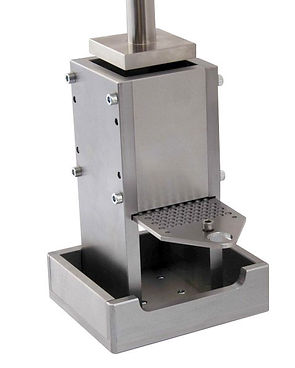
Food Testing Fixtures
Texture Profile Analysis (TPA) is a specialized mechanical testing discipline that uses controlled compression cycles—typically performed with compression platens, probes, or purpose-built jigs—to replicate the forces and deformation experienced during mastication. By compressing a specimen once or multiple times, TPA quantifies key material properties such as hardness, cohesiveness, springiness, adhesiveness, and chewiness, making it widely used in food science and consumer product development. Universal Grip offers a range of application-specific grips and fixtures for Texture Profile Analysis, including the Ottawa Cell, which is commonly used to evaluate pasta extrusion quality by measuring firmness and structural integrity under standardized compressive loading conditions.