
ASTM D6641
Combined Loading Compression (CLC) Fixture


ASTM D6641 Compression Platens – Universal Grip Data Sheet (PDF)
Theory:
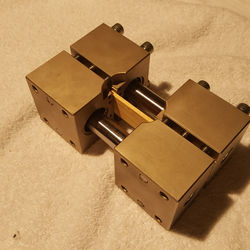
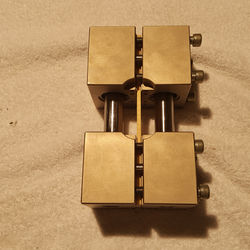
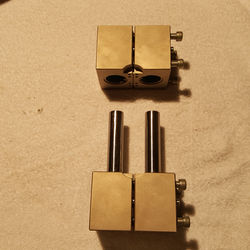
ASTM D6641 covers a test for polymer matrix materials using an ASTM specific compression fixture. The fixture is designed to compress the sample from the sides, prior to the test. The sides are compressed by tightening multiple torque screws which squeeze the fixture together.
Once the sample has been mounted, it is then compressed until failure. There are several types of failure modes and it can often be difficult to discern the exact failure mode without strain gauges. The test seeks to create a total compression failure, and any buckling failures should be discarded and remedied with better test preparation.
Geometry:
The standard ASTM D6641 specimen is a flat rectangular bar 140 mm (5.5 in) long and typically 13 mm (0.5 in) wide, with a 13 mm (0.5 in) unsupported gauge length between the fixture halves. Untabbed specimens are most common; tabs can be added for high-strength laminates. Each end sits flush with the top and bottom surfaces of the fixture, so load goes into the specimen through both the clamped faces (shear) and the ends, which is where the name "combined loading" comes from.
Solution:
Compression Platens are required in order to use this fixture. Two fixed platens are used to compress the fixture and create failure on the sample. The fixture ships with embedded jaws with serrated style faces. Also included are two .5x.5" spacer bars which help with sample set up.
A 50kN or 100kN Galdabini universal testing machine is recommended for this test. The Galdabini machines can ship as a plug & play solution with the procedure for ASTM D6641 pre-loaded onto the system. These material testing systems are flexible, easy to use, and last a long time with virtually no maintenance.
Analysis:
Compressive Strength is given when a total compressive failure is achieved. The units are usually megapascals or also ksi. There is a specific equation called the Euler buckling equation which can serve to predict the buckling stress.
Test speed: load at a constant crosshead rate of 1.3 mm/min (0.05 in/min). Test at least five specimens.
Compressive strength: σ = Pmax / (w × h), where Pmax is the maximum load, w is the specimen width and h is the thickness. Bond back-to-back strain gauges on the gauge section to measure modulus and check bending; keep percent bending below 10% for a valid result.
Similar Specifications:
ASTM D3410: compression by shear loading (wedge-grip fixture)
ASTM D695 (modified): end-loaded compression, often run with tabbed composite specimens
ISO 14126: in-plane compressive properties of fiber-reinforced plastic composites
ASTM D7137: compression after impact (CAI) of damaged composite plates
ASTM D6641 FAQ:
What is the ASTM D6641 specimen size?
A flat bar 140 mm (5.5 in) long and typically 13 mm (0.5 in) wide, with a 13 mm (0.5 in) unsupported gauge length. Thickness depends on the laminate.
What is the difference between ASTM D6641 and ASTM D3410?
D3410 loads the specimen only through shear at the gripped faces, using a heavier wedge-grip fixture. D6641 combines end loading with face shear in a smaller, lighter fixture, and often works with untabbed specimens, which lowers specimen cost.
What testing machine do I need for ASTM D6641?
A universal testing machine with compression platens. A 50 kN or 100 kN frame covers most polymer matrix composites, and a Galdabini UTM can ship with the D6641 procedure pre-loaded.

 |  |  |
|---|---|---|
 |  |  |
 |  |  |
 |  |  |