
ASTM D5528
Mode I DCB Fracture Toughness Fixture for Composites
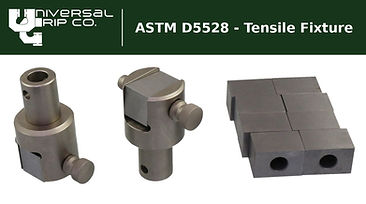
ASTM D5528 Tensile Fixture – Universal Grip Data Sheet (PDF)
ASTM D5528 measures the Mode I interlaminar fracture toughness, GIc, of unidirectional fiber-reinforced composites using the double cantilever beam (DCB) specimen. The two arms of a pre-cracked laminate are pulled apart so a delamination grows from a film insert. Universal Grip supplies a low-mass opening fixture with clevises that pin the piano hinges or loading blocks bonded to the specimen.
What ASTM D5528 Measures
The test reports the critical strain energy release rate for opening-mode delamination, GIc, at initiation and as the crack grows. Load, opening displacement and delamination length are recorded throughout. The standard defines three data reduction methods: modified beam theory, compliance calibration and modified compliance calibration. GIc is a key input for damage tolerance and delamination models.
How the ASTM D5528 Test Works
Lay up a unidirectional laminate with a non-adhesive film insert at the mid-plane to start the delamination.
Bond piano hinges or loading blocks to the top and bottom of the cracked end.
Pin the hinges or blocks into the fixture clevises.
Open the arms at a constant crosshead rate while marking and recording delamination growth.
Calculate GIc using one of the data reduction methods in the standard.
Specimens and Setup
Typical specimens are at least 125 mm long, 20 to 25 mm wide and 3 to 5 mm thick, with an initial delamination of about 50 mm from the load line.
Coat one edge with thin white paint and mark it so crack growth is easy to read.
Use an adhesive for the hinges or blocks that will hold at the peak load.
Support long free ends so their weight does not bias low-force readings.
Confirm the loading rate and data reduction method against your copy of the current standard.
Universal Grip ASTM D5528 Fixture
Clevises accept piano hinges or loading blocks bonded to the specimen
Free rotation at the load points avoids moments on the arms
Low-mass design for accurate low-force measurement
Open access for crack-length viewing and marking
Optional support for long free ends
1 kN standard capacity; higher capacities on request
Applications
Carbon and glass/epoxy laminates
Thermoplastic matrix composites
Interlaminar toughness screening
Aerospace material qualification
Related Standards and Products
Send us your specimen dimensions, required capacity and machine connection through our contact page and we will quote an ASTM D5528 DCB fixture. Request a quote
ASTM D5528 FAQ
What does DCB stand for?
Double cantilever beam. The specimen is a laminate with a starter crack at one end, so its two arms act like cantilever beams when they are pulled apart.
Piano hinges or loading blocks?
Both are allowed. Hinges are light and let the arms rotate freely; blocks are stiffer and suit thicker or tougher laminates. Our clevises accept either, so tell us the pin diameter when ordering.
What load cell should I use?
DCB loads are low, often well under 1 kN, so a small load cell gives better resolution. Our fixture is built light for that reason.
Do you make fixtures for other delamination modes?
Yes. We also build a mixed-mode bending (MMB) fixture for ASTM D6671, which combines Mode I and Mode II loading. Ask us about it through our contact page.
ISO equivalent: see our ISO 15024 mode I DCB fracture toughness guide.