top of page

Search
Material Testing


3-Point vs. 4-Point Bend Testing: ASTM D790, D6272 and C1161 Explained
The difference between 3-point and 4-point flexural testing, with spans, speeds, formulas and fixtures for ASTM D790 (plastics), D6272 (4-point plastics) and C1161 (ceramics), plus common mistakes and videos.

Chris Thomas
18 hours ago6 min read


How to Choose a Universal Testing Machine: Capacity, Frame Type, Software and Accessories (Buyer's Guide)
A practical buyer's guide to universal testing machines: how to size capacity with headroom, single vs. dual column, electromechanical vs. hydraulic, travel and column width, accuracy and calibration, software, accessories, price drivers and when a Mark-10 frame is enough.
Chris Thomas
2 days ago6 min read


Temperature Chambers for Universal Testing Machines: A Buyer's Guide to Hot and Cold Testing (-80 °C to +350 °C)
How to choose a temperature chamber for tensile, compression and flexure testing: temperature range, LN2 vs. mechanical cooling, grips and extensometers at temperature, and fitting a chamber to an Instron, MTS, Zwick or Shimadzu frame.

Mark Edwards
Oct 55 min read


Mark-10 Test Frame vs. Universal Testing Machine: Which Does Your Lab Need?
Mark-10 force frame or full universal testing machine? Compare capacity, tests, strain measurement and à la carte software so you buy what your lab needs and nothing more.
Mark Edwards
Oct 34 min read
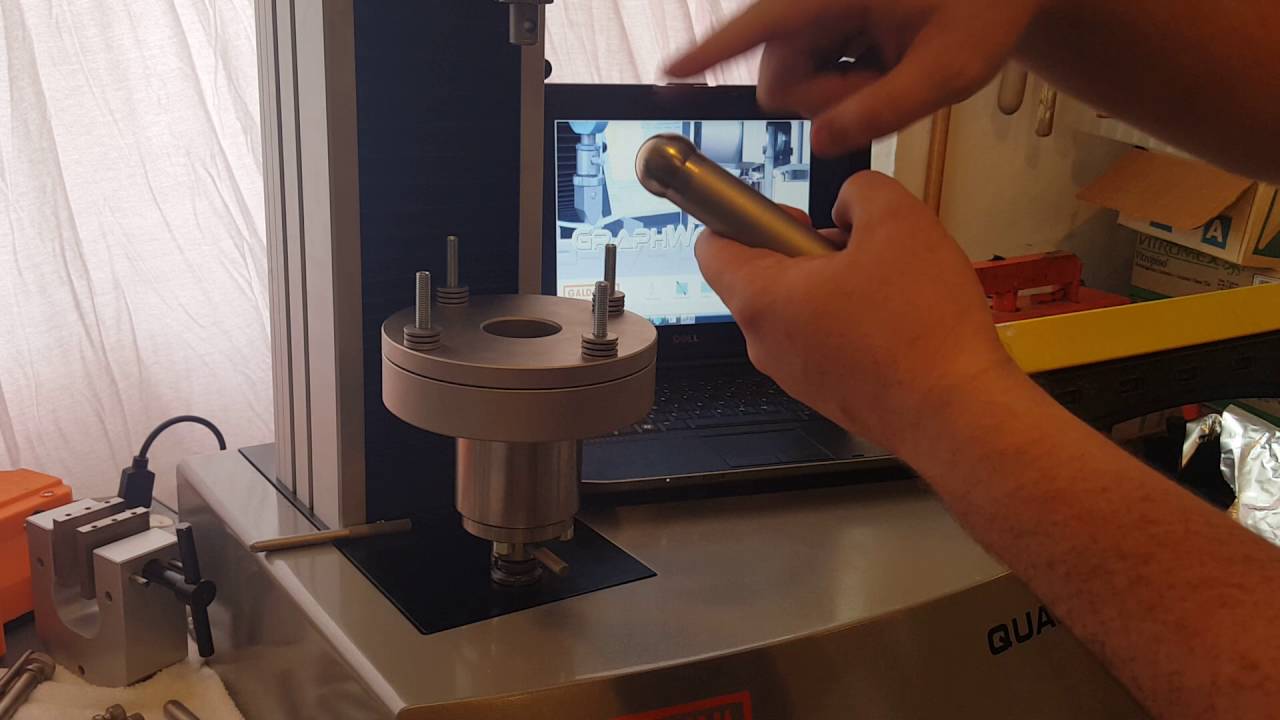
ASTM D3787 Ball Burst Testing: A Complete Guide to the UniversalGripCo Ball Burst Puncture Fixture
Introduction In the field of textile and flexible material testing, understanding how a material behaves under multidirectional stress is critical for predicting real-world performance. Fabrics used in apparel, medical textiles, industrial materials, and geotextiles are frequently subjected to forces that do not occur purely along a single axis. Instead, these materials often experience localized pressure and multi-directional stress , which can lead to puncture or bursting f
Mark Edwards
Mar 267 min read

UniversalGripCo Arbor Press: Precision Force Application for Laboratory and Materials Testing
Arbor Press Cutting Sample Introduction In materials testing laboratories and engineering environments, many tasks require controlled compressive force to assemble components, prepare test fixtures, or install precision mechanical parts. While large automated systems such as universal testing machines handle tensile and compression testing, technicians frequently rely on smaller manual tools to prepare equipment and samples before testing begins. One of the most reliable too
Mark Edwards
Mar 266 min read
bottom of page