
Home › Products › Vise Grips › Four-Jaw Shoulder Grip


Four-Jaw Shoulder Grip – Chuck Grip for Ø 2 to 250 mm
Four-jaw chuck grip with hardened pyramid-serrated jaws for round bars, tubes and cylindrical parts from Ø 2 to 250 mm, self-centering or independent.
Brand: Universal Grip | Model: UGC-VG-030 | ● Configured to order
Six chuck sizes from 80 to 250 mm hold specimens from Ø 2 to 250 mm (0.08 to 9.8 in)
Self-centering jaws close together with 0.02–0.04 mm concentricity
Independent-jaw version sets each jaw separately for irregular or stepped parts
Hardened, pyramid-serrated jaw faces resist slipping
Clamping force of 1.7 to 4.6 kN per jaw, depending on chuck size
Female clevis for a 15.9 mm (5/8 in) pin; other couplings via adapter
Downloads and standards
Trusted by Global Companies


Four-jaw chuck grip for round and cylindrical specimens
The UGC-VG-030 holds round specimens the way a lathe chuck does: four hardened jaws close on the part from four sides. A two-jaw vise grip touches a cylinder along only two lines, which can flatten tubes or let a smooth bar rotate. Four jaws share the clamping force around the circumference and center the part on the load axis. The grip clamps on the outside diameter, so the specimen does not need a machined shoulder or head. It suits labs testing bars, tubes, housings and assembled cylindrical components, including pull-out tests where a part is held by its body while something is drawn out of it.
Self-centering or independent jaws
Two jaw arrangements are available. In the self-centering version all four jaws move together, so a round specimen is placed on the chuck axis automatically, concentric to within 0.02 to 0.04 mm (0.0008 to 0.0016 in) depending on chuck size. In the independent version each jaw is set on its own, the better choice for castings, out-of-round parts and stepped components. Both use hardened jaw faces with pyramid serration, and special jaws for filter elements and stepped parts can be made.
Chuck sizes
Clamping force and torque below are per jaw and rise with chuck size:
80 mm chuck: specimens Ø 2–70 mm, with an extra-long 160 mm coupling
100 mm chuck: Ø 2–90 mm, 1.7 kN per jaw, 50 Nm, 0.02 mm concentricity
125 mm chuck: Ø 3–125 mm, 2.4 kN per jaw, 75 Nm, 0.03 mm
160 mm chuck: Ø 4–160 mm, 3.1 kN per jaw, 120 Nm, 0.03 mm
200 mm chuck: Ø 4–200 mm, 3.7 kN per jaw, 160 Nm, 0.04 mm
250 mm chuck: Ø 6–250 mm, 4.6 kN (1,034 lbf) per jaw, 180 Nm, 0.04 mm
Typical applications
Round bars and tubes, filter element pull-out tests, cylindrical components and housings, and stepped or irregular parts are the main uses. For filter testing, the chuck grips the filter body while the element or end cap is pulled, giving a direct measure of bond or press-fit strength.
Coupling, capacity and machine fit
The standard coupling is a female clevis for a 15.9 mm (5/8 in) pin; other machine connections are handled with adapters. Maximum tensile load is confirmed on request for the chuck size and specimen, so tell us the force you expect. Smaller chucks pair well with a Galdabini benchtop universal testing machine. If your specimen does have a threaded end or machined head, a shoulder grip or bolt grip may be the simpler fixture.
Give us the specimen diameter range, the jaw arrangement you need and your machine coupling, and we will size the chuck: request a quote.
Product video
At a glance
Test type: Tensile, pull-out
Chuck diameter: 80, 100, 125, 160, 200 or 250 mm
Specimen diameter: Ø 2–250 mm (depending on chuck size)
Jaw arrangement: Four jaws, self-centering or independently adjustable
Clamping force per jaw: 1.7–4.6 kN (depending on chuck size)
Max. torque: 50–180 Nm (depending on chuck size)
Four-Jaw Shoulder Grip Specifications
TEST TYPE
Tensile, pull-out
CHUCK DIAMETER
80, 100, 125, 160, 200 or 250 mm
SPECIMEN DIAMETER
Ø 2–250 mm (depending on chuck size)
JAW ARRANGEMENT
Four jaws, self-centering or independently adjustable
CLAMPING FORCE PER JAW
1.7–4.6 kN (depending on chuck size)
MAX. TORQUE
50–180 Nm (depending on chuck size)
CONCENTRICITY
0.02–0.04 mm
JAW SURFACE
Pyramid serrated, hardened
COUPLING
Female clevis, Ø 15.9 mm (5/8 in) pin; others via adapter
MAX. LOAD
On request
PART REF.
UGC-VG-030
Models & Options
80 mm chuck — Specimens Ø 2–70 mm; extra-long 160 mm coupling (Specify at order)
100 mm chuck — Ø 2–90 mm; 1.7 kN per jaw; 50 Nm; 0.02 mm concentricity (Specify at order)
125 mm chuck — Ø 3–125 mm; 2.4 kN per jaw; 75 Nm; 0.03 mm (Specify at order)
160 mm chuck — Ø 4–160 mm; 3.1 kN per jaw; 120 Nm; 0.03 mm (Specify at order)
200 mm chuck — Ø 4–200 mm; 3.7 kN per jaw; 160 Nm; 0.04 mm (Specify at order)
250 mm chuck — Ø 6–250 mm; 4.6 kN per jaw; 180 Nm; 0.04 mm (Specify at order)
Independent-jaw version — Four individually adjustable jaws for irregular shapes, 80 to 250 mm (Specify at order)
Special jaws — For filter elements and stepped parts (On request)
What's Included
Four-jaw chuck grip in the chuck size and jaw arrangement ordered
Hardened pyramid-serrated jaws, fitted
Female clevis coupling for a 15.9 mm (5/8 in) pin
Special jaws and machine adapters on request
Supported Test Standards
Standards list
Compatible Grips & Fixtures
Shoulder Grips — For round specimens with a machined head or shoulder
Bolt Grips — For threaded fasteners and studs
Benchtop Universal Testing Machines — Galdabini frames for pull-out and tensile tests
Adapters — Couplings for other machine connections
Metals Testing — Fixtures for bars, tubes and metal components
“Customer quote”
Related Equipment
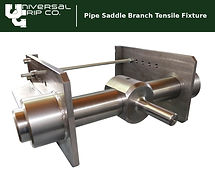
UGC-VG-020 Pipe Saddle Branch Tensile Fixture
Custom steel fixture that supports a polypropylene pipe on a mandrel while the machine pulls the saddle branch outlet to
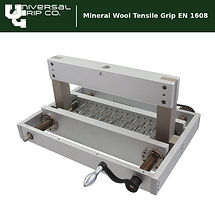
UGC-VG-040 Mineral Wool Tensile Grip EN 1608
Needle-plate grip for the tensile strength of mineral wool and insulation boards parallel to their faces, sized for 225

UGC-VG-010 Vise Grips for Broad Textile Samples
Screw vise grips with serrated jaw plates 70, 150 or 200 mm wide for textile strips, films and thin sheet up to 4 mm thi

UGC-VG-050 Screw Grips 2-20 kN
Thumb-screw bar grips for flat specimens up to 8 mm thick: 2 kN anodized aluminum for room temperature or 20 kN steel fo
Four-Jaw Shoulder Grip FAQ
What specimen sizes does the UGC-VG-030 hold?
From Ø 2 mm in the smallest chucks up to Ø 250 mm in the 250 mm chuck. Each chuck size covers its own diameter range.
Should I choose self-centering or independent jaws?
Self-centering suits round bars and tubes, centering them to 0.02–0.04 mm. Independent jaws are better for castings, stepped parts and anything out of round.
Is the clamping force the same as the tensile capacity?
No. The 1.7–4.6 kN figures are clamping force per jaw. Maximum tensile load is confirmed on request for your chuck size and specimen.
Can it be used for filter pull-out tests?
Yes. Filter element pull-out is a listed application, and special jaws for filters can be made.
Does my specimen need a shoulder or thread?
No. The jaws clamp on the outside diameter. Parts with a head or thread may suit our shoulder grips instead.
How does it attach to my machine?
Through a female clevis for a 15.9 mm (5/8 in) pin, with adapters for other couplings.