
Home › Products › Vise Grips › Mineral Wool Tensile Grip EN 1608


Mineral Wool Tensile Grip EN 1608 – Needle Plate Grip
Needle-plate grip for the tensile strength of mineral wool and insulation boards parallel to their faces, sized for 225 x 500 mm specimens.
Brand: Universal Grip | Model: UGC-VG-040 | ● Configured to order
Rows of needles pierce and hold soft fibrous boards across their full width
Crank-driven spindles close both clamping plates evenly
Sized for 225 x 500 mm (8.9 x 19.7 in) specimens
Choice of manual crank or motorized clamping drive
Rigid aluminum frame with steel spindles and a central machine connection
Built for EN 1608, DIN 18164, GOST 17177 and GOST 10140 tests
Standards: EN 1608 · DIN 18164 · GOST 17177 · GOST 10140
Trusted by Global Companies


Needle-plate tensile grip for mineral wool insulation
The UGC-VG-040 is a dedicated grip for determining the tensile strength of mineral wool and other thermal insulation boards parallel to their faces. Soft fibrous boards are hard to hold in an ordinary vise grip: clamp them tightly enough to stop slipping and the fibers crush, clamp lightly and the specimen pulls out before it breaks. This grip avoids both by piercing the board with needles, so the load is carried into the fiber structure itself. Insulation manufacturers and building materials labs use it to confirm that boards can withstand handling, transport and installation loads.
How it works
Two clamping plates carry rows of needles. Turning the crank drives a spindle system that brings both plates together evenly, so the needles penetrate the specimen across its full width instead of biting harder on one side. The frame is aluminum with steel spindles, which keeps it rigid while limiting weight on the load train, and it connects to the machine at a central point on the test axis.
Manual or motorized clamping
Manual version: crank-operated clamping for 225 x 500 mm specimens
Motorized version: motor-driven clamping for the same specimen size, useful when a lab runs many boards per shift
Specimen size and standards
The grip is sized for 225 x 500 mm (8.9 x 19.7 in) specimens and built for tests to EN 1608, DIN 18164, GOST 17177 and GOST 10140. It is intended for ambient-temperature testing. Typical work covers mineral wool insulation boards, other thermal insulation products, building material quality control and checks of transport and handling strength. Other foam and insulation setups are on our foam testing page.
Capacity, coupling and machine fit
Maximum load is confirmed on request based on the boards you test. The grip connects through a clevis pin coupling, and adapters cover other pin sizes. Because the specimen is 500 mm long and the fixture adds height of its own, check that your frame has enough clearance between crossheads; a floor-standing universal testing machine is often the comfortable choice. If you also test compressive behavior of the same boards, our compression platens complete the setup.
Tell us whether you need the manual or motorized version, your specimen size and your machine coupling, and we will prepare a quote: request a quote.
Mineral Wool Tensile Grip EN 1608 Specifications
TEST TYPE
Tensile, parallel to faces
SPECIMEN SIZE
225 x 500 mm
CLAMPING
Needle plates, spindle-driven
OPERATION
Manual crank or motorized
FRAME MATERIAL
Aluminum with steel spindles
MAX. LOAD
On request
COUPLING
Clevis pin coupling; other sizes via adapters
TEMPERATURE RANGE
Ambient
STANDARDS
EN 1608, DIN 18164, GOST 17177, GOST 10140
PART REF.
UGC-VG-040
Models & Options
Manual version — Crank-operated clamping, specimens 225 x 500 mm (Specify at order)
Motorized version — Motor-driven clamping, specimens 225 x 500 mm (Specify at order)
Coupling adapter — For machines with a different clevis pin size (On request)
What's Included
Grip frame with two needle clamping plates and steel spindles
Crank drive (manual version) or clamping motor (motorized version)
Central clevis pin connection; adapters for other frames on request
Drawings and 3D models available to check frame clearance
Supported Test Standards
EN 1608 — Thermal insulating products: tensile strength parallel to faces
DIN 18164 — German standard for insulation materials in building
GOST 17177 — Test methods for building thermal insulation materials and products
GOST 10140 — Mineral wool thermal insulation boards
Compatible Grips & Fixtures
Floor-Standing Testing Machines — Frames with room for 500 mm insulation specimens
Foam Testing — Fixtures for foams and insulation materials
Compression Platens — For compressive tests on the same boards
Adapters — Couplings for other clevis pin sizes
Tensile Testing — Overview of tensile test setups
“Customer quote”
Related Equipment
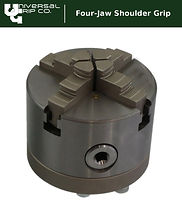
UGC-VG-030 Four-Jaw Shoulder Grip
Four-jaw chuck grip with hardened pyramid-serrated jaws for round bars, tubes and cylindrical parts from Ø 2 to 250 mm,

UGC-VG-050 Screw Grips 2-20 kN
Thumb-screw bar grips for flat specimens up to 8 mm thick: 2 kN anodized aluminum for room temperature or 20 kN steel fo
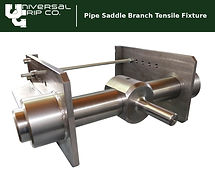
UGC-VG-020 Pipe Saddle Branch Tensile Fixture
Custom steel fixture that supports a polypropylene pipe on a mandrel while the machine pulls the saddle branch outlet to
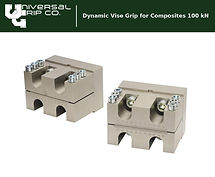
UGC-VG-060 Dynamic Vise Grip for Composites 100 kN
Bolt-clamped 100 kN vise grips for static and tension-tension fatigue tests on polymer composites, with chamber and wate
Mineral Wool Tensile Grip EN 1608 FAQ
What does the UGC-VG-040 test?
The tensile strength of mineral wool and other thermal insulation boards parallel to their faces, as described in EN 1608.
Why does it use needles instead of serrated jaws?
Fibrous insulation crushes under high clamping pressure. Needles pierce the board and carry load into the fibers without squeezing them flat.
What specimen size does it take?
225 x 500 mm (8.9 x 19.7 in). Tell us if your standard calls for a different size.
Manual or motorized: which should I choose?
Both clamp the same specimen. The motorized version saves operator effort when you run large numbers of boards.
Can it be used in a temperature chamber?
It is specified for ambient-temperature testing.
What machine does it need?
Any frame with enough clearance for the fixture plus a 500 mm specimen; a floor-standing testing machine is often the easiest fit.