
Home › Products › Vise Grips › Pipe Saddle Branch Tensile Fixture


Pipe Saddle Branch Tensile Fixture – Polypropylene Pipe
Custom steel fixture that supports a polypropylene pipe on a mandrel while the machine pulls the saddle branch outlet to test joint strength.
Brand: Universal Grip | Model: UGC-VG-020 | ● Configured to order
Internal pipe mandrel supports the main pipe so the wall is not crushed
Steel end plates joined by tie rods form a stiff test frame
Branch outlet is pulled along the machine axis in straight tension
Adjustable hole pattern positions the pipe to suit the branch location
Built to the customer's pipe and branch outlet diameters
Designed for saddle branch pull-out tests to GOST R 52779
Standards: GOST R 52779
Trusted by Global Companies


Tensile fixture for polypropylene saddle branch fittings
The UGC-VG-020 is a special fixture for measuring how well a saddle branch stays attached to a polypropylene pipe. Saddle branches are fused or clamped onto the outside of a main pipe to create an outlet, and the joint has to resist being pulled away. This fixture holds the pipe section rigidly while the testing machine pulls on the branch outlet, so the recorded force reflects the pull-out resistance of the joint rather than the pipe deforming. It is intended for plastic piping manufacturers, fitting suppliers and the labs that qualify their products.
How the fixture is built
The main pipe slides over a mandrel that supports it from the inside, so the wall does not collapse or ovalize as load builds. The mandrel is carried between two steel end plates, and tie rods tie the plates into a stiff frame that does not flex during the pull. The branch outlet points along the machine axis, so the joint is loaded in straight tension instead of peel. An adjustable hole pattern lets the operator position the pipe to suit where the branch sits on the specimen. Specimens are mounted by hand.
Made to your pipe dimensions
Saddle branches come in many combinations of main pipe and outlet size, so this fixture is sized to the customer's specimens rather than sold in fixed catalog sizes. To quote, we need:
The pipe outside diameter
The branch outlet diameter
The capacity required, based on the expected pull-out force
Your testing machine's coupling
Maximum load is set on request to match the joints you test. The fixture is made of steel and connects through a clevis pin coupling, with other pin sizes covered by adapters.
Typical applications
Uses include joint strength checks on polypropylene pipe fittings, routine quality control in plastic piping production, and qualification of new saddle branch designs. The fixture was built for saddle branch tests to GOST R 52779. If you work to a different specification, send the specimen geometry and loading requirement and we will check whether the same layout applies. For other polymer test setups, see our plastics testing page.
Choosing a testing machine
Size the frame by the expected pull-out force and the fixture's length. Smaller fittings may only need a 10 kN benchtop universal testing machine, while large-diameter branches can call for a floor-standing testing machine with more space between the crossheads. Tell us how you plan to connect to the branch outlet and we will advise on the upper side of the load train as part of the design.
Send the pipe and branch diameters with your machine details and we will engineer the fixture around them: request a quote.
Pipe Saddle Branch Tensile Fixture Specifications
TEST TYPE
Tensile (branch pull-out)
SPECIMEN
Polypropylene pipe with saddle branch
PIPE / BRANCH SIZE
Made to customer specimen dimensions
CONSTRUCTION
Steel end plates, pipe mandrel, tie rods
MATERIAL
Steel
MAX. LOAD
On request
COUPLING
Clevis pin coupling; other sizes via adapters
OPERATION
Manual specimen mounting
STANDARD
GOST R 52779
PART REF.
UGC-VG-020
Models & Options
Custom-sized fixture — Mandrel, end plates and hole pattern sized to your pipe and branch diameters (On request)
Coupling adapter — Connects the fixture to machines with a different clevis pin size (On request)
What's Included
Fixture frame with steel end plates and tie rods
Pipe mandrel sized to the specified pipe
Clevis pin connection to the machine; pin-size adapters if needed
Fixture drawings supplied for approval on request
Supported Test Standards
GOST R 52779 — Saddle branch pull-out test for polypropylene pipe fittings
Compatible Grips & Fixtures
10 kN Benchtop Testing Machine — Galdabini frame for smaller fittings
Floor-Standing Testing Machines — More capacity and daylight for large branches
Plastics Testing — Test setups for polymer materials and parts
Adapters — Couplings for other clevis pin sizes
Tensile Testing — Overview of tensile test setups and fixtures
“Customer quote”
Related Equipment

UGC-VG-010 Vise Grips for Broad Textile Samples
Screw vise grips with serrated jaw plates 70, 150 or 200 mm wide for textile strips, films and thin sheet up to 4 mm thi
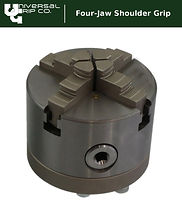
UGC-VG-030 Four-Jaw Shoulder Grip
Four-jaw chuck grip with hardened pyramid-serrated jaws for round bars, tubes and cylindrical parts from Ø 2 to 250 mm,
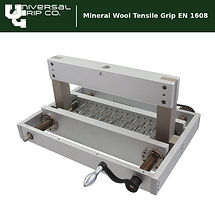
UGC-VG-040 Mineral Wool Tensile Grip EN 1608
Needle-plate grip for the tensile strength of mineral wool and insulation boards parallel to their faces, sized for 225

UGC-VG-050 Screw Grips 2-20 kN
Thumb-screw bar grips for flat specimens up to 8 mm thick: 2 kN anodized aluminum for room temperature or 20 kN steel fo
Pipe Saddle Branch Tensile Fixture FAQ
What does the UGC-VG-020 measure?
The pull-out resistance of a saddle branch fused or clamped onto a polypropylene pipe. The pipe is held on a mandrel and the branch outlet is pulled along the machine axis.
Is this a standard catalog size?
No. Each fixture is made to the customer's pipe outside diameter and branch outlet diameter, so we need both to quote.
Why does the fixture use a mandrel?
It supports the pipe from inside so the wall does not crush or ovalize during the pull, keeping the measurement focused on the joint.
What capacity is it rated to?
Capacity is on request and set to suit the expected pull-out force of your fittings.
Which standard was it designed for?
GOST R 52779. For other specifications, send the test requirements and we will check whether the layout fits.
How does it connect to my machine?
Through a clevis pin coupling, with adapters for other pin sizes.