
Home › Products › Vise Grips › Dynamic Vise Grip for Composites 100 kN


Dynamic Vise Grip for Composites 100 kN – Fatigue Rated
Bolt-clamped 100 kN vise grips for static and tension-tension fatigue tests on polymer composites, with chamber and water-cooled versions.
Brand: Universal Grip | Model: UGC-VG-060 | ● Configured to order
Rated 100 kN (22,480 lbf) for both static and fatigue loading
Multiple cap screws clamp the wedge jaws with no backlash under cyclic load
Engraved centering scale for repeatable specimen alignment
Operating range -70 to +180 °C (-94 to 356 °F)
Pull-rod version reaches into temperature chambers
Water-cooled version protects the load cell and actuator from heat
Standards: ASTM D3039 · ISO 527-4 · ASTM D3479
Trusted by Global Companies


100 kN vise grips for fatigue testing of polymer composites
The UGC-VG-060 is a heavy vise grip built for dynamic and fatigue tests on polymer composite specimens up to 100 kN (22,480 lbf). Fatigue work is unforgiving on grips: any play in the jaws lets the specimen shift slightly every cycle, which shows up as noise in the load signal, fretting at the tabs and premature failures in the grip area. This design removes that play by clamping the jaws with a row of cap screws, so the hold stays rigid through long fatigue runs. It is aimed at composites labs, aerospace and automotive suppliers, and research groups qualifying fiber-reinforced laminates.
How it works
The specimen sits between bolt-clamped wedge jaws, and several cap screws are tightened to lock them in place. Once torqued, the jaws cannot creep or rattle, which is what gives backlash-free clamping under tension-tension cycling. An engraved scale on the grip lets the operator center each specimen in the same position, which matters for keeping bending out of thin laminates. The body is nickel-plated steel, and the grip is rated for both static and dynamic loading at the full 100 kN.
Versions for hot and cold testing
Pull-rod version: extends the grip into a temperature chamber so the specimen can be tested from -70 to +180 °C while the load cell stays outside
Water-cooled version: integrated cooling keeps heat from reaching the load cell and actuator, over the same -70 to +180 °C range
Typical applications
Polymer matrix composites, fiber-reinforced laminates, fatigue testing and high- or low-temperature testing are the core uses. The grip suits specimens for static tests such as ASTM D3039 and ISO 527-4, and for tension-tension fatigue work such as ASTM D3479. Our environmental chambers pair with the pull-rod version.
Choosing the right setup
Fatigue tests need a dynamic test system, so this grip is normally installed on the customer's servo-hydraulic or electrodynamic frame. For static strength tests on the same specimens, it also fits a 100 kN Galdabini benchtop universal testing machine. Coupling and specimen size are set on request, and adapters cover most actuator and load cell threads. If your loads are lower, the UGC-VG-160 fatigue fixture is a lighter 30 kN option; other dynamic grips are listed under fatigue grips.
Share your specimen width and thickness, test temperature and frame coupling, and we will specify the chamber or water-cooled build: request a quote.
Dynamic Vise Grip for Composites 100 kN Specifications
MAX. LOAD
100 kN (static and dynamic)
TEST TYPE
Tensile, tension-tension fatigue
CLAMPING
Bolt-clamped wedge jaws
OPERATION
Manual, cap screws
TEMPERATURE RANGE
-70 to +180 °C
MATERIAL / FINISH
Steel, nickel-plated
CENTERING
Engraved centering scale
COUPLING
On request
SPECIMEN SIZE
On request
PART REF.
UGC-VG-060
Models & Options
Pull-rod version — For use inside temperature chambers, -70 to +180 °C (Specify at order)
Water-cooled version — Integrated cooling to protect the load train, -70 to +180 °C (Specify at order)
Coupling adapter — Matches the grip to your actuator or load cell thread (On request)
What's Included
Vise grips with bolt-clamped wedge jaws and cap screws
Pull rods (chamber version) or integrated water cooling (water-cooled version)
Coupling to suit your frame, specified at quotation
Drawings and 3D models on request for fixture planning
Supported Test Standards
ASTM D3039 — Tensile properties of polymer matrix composite materials
ISO 527-4 — Tensile properties of isotropic and orthotropic fiber-reinforced plastics
ASTM D3479 — Tension-tension fatigue of polymer matrix composite materials
Compatible Grips & Fixtures
Fatigue Grips — Other grips for cyclic and dynamic testing
Environmental Chambers — Chambers for -70 to +180 °C tests with the pull-rod version
100 kN Benchtop Testing Machine — Galdabini frame for static composite tests
Bone Cement Fatigue Test Fixture — Lighter 30 kN backlash-free fatigue grips
Adapters — Couplings for actuator and load cell threads
“Customer quote”
Related Equipment

UGC-VG-160 Bone Cement Fatigue Test Fixture
Backlash-free 30 kN fatigue grips, about 1.5 kg each, for force-controlled tests on acrylic bone cement and other flat o

UGC-VG-050 Screw Grips 2-20 kN
Thumb-screw bar grips for flat specimens up to 8 mm thick: 2 kN anodized aluminum for room temperature or 20 kN steel fo

UGC-VG-070 Small Vise Grip 100 N
Miniature 100 N screw vise grip weighing 57 g, with interchangeable 15 x 15 mm jaws for fine wires, fibers, foils and sm
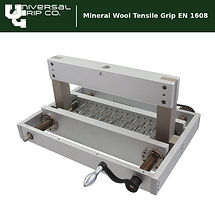
UGC-VG-040 Mineral Wool Tensile Grip EN 1608
Needle-plate grip for the tensile strength of mineral wool and insulation boards parallel to their faces, sized for 225
Dynamic Vise Grip for Composites 100 kN FAQ
Is the UGC-VG-060 rated for fatigue as well as static tests?
Yes. It is rated 100 kN (22,480 lbf) for both static and dynamic loading.
Why use bolt clamping instead of a self-tightening grip?
Multiple cap screws lock the jaws with no backlash, so the specimen cannot shift during load reversals in tension-tension cycling.
What temperatures can it handle?
-70 to +180 °C (-94 to 356 °F). The pull-rod version reaches into a chamber and the water-cooled version protects the load train.
Which composite standards does it suit?
Specimens for static tests such as ASTM D3039 and ISO 527-4, and fatigue work such as ASTM D3479.
How does it connect to my fatigue frame?
Coupling is specified on request to match your frame; adapters are available.
How do I center the specimen?
An engraved scale on the grip shows the center line, so each specimen goes in at the same position.