
Composite Test Fixture Buyer's Guide: ASTM D3039, D5379, D7078, D2344, D6641 and More
Characterizing a fiber-reinforced composite takes more than one test. A typical lab needs tension, compression, in-plane shear, interlaminar shear and notched (open-hole) strength, and almost every one of those ASTM methods calls for its own grip or fixture on your universal testing machine. Buy the wrong one and you get invalid failure modes, retests and lost weeks. This guide walks through each method, what its fixture has to do, and what to look for before you buy.
Quick pick: property, standard, fixture
Tensile strength and modulus: ASTM D3039 with wedge grips
In-plane shear: ASTM D5379 (Iosipescu) or ASTM D7078 (V-notched rail shear)
Interlaminar shear: ASTM D2344 short-beam shear fixture
Compressive strength: ASTM D6641 combined loading compression (CLC) fixture
Notched strength: ASTM D5766 open-hole tension and ASTM D6484 open-hole compression
Tension: ASTM D3039 wedge grips
ASTM D3039 is the workhorse tensile test for polymer matrix composites. Specimens are flat, straight-sided strips, typically 250 mm long. Unidirectional 0° coupons are commonly 15 mm wide and 1 mm thick with bonded end tabs, while balanced, symmetric laminates are commonly 25 mm wide and 2.5 mm thick. Modulus is calculated as a chord between 1,000 and 3,000 microstrain, so you need an extensometer or strain gauges, not crosshead travel.

What to look for: wedge grips with enough capacity for your strongest laminate, jaw faces matched to your tab material, and good alignment so bending doesn't cause failures at the tabs. The same grips also run ASTM D3518 (±45° in-plane shear) and ASTM D5766 open-hole tension, so one good set covers three methods. Pair them with a video extensometer to measure modulus without touching the specimen.
In-plane shear: ASTM D5379 vs. ASTM D7078
Both methods load a V-notched specimen so that the section between the notches sees close to pure shear. Shear strain is measured with strain gauges at ±45° in the gauge section. The difference is the specimen size and how load gets into it.
ASTM D5379 Iosipescu fixture
The ASTM D5379 V-notched beam fixture uses a small specimen, about 76 mm long and 20 mm wide, with 90° V-notches on both edges. One half of the fixture moves against the other, loading the specimen through its edges. It is compact and economical, and it works well for unidirectional materials and fine-weave fabrics.


ASTM D7078 V-notched rail shear fixture
The ASTM D7078 fixture uses a larger specimen, about 76 mm by 56 mm, clamped across its faces by bolted rails. Loading through the faces instead of the edges lets it reach much higher shear loads, so it handles thicker, stronger laminates and coarse textile architectures that are too big for the Iosipescu specimen.
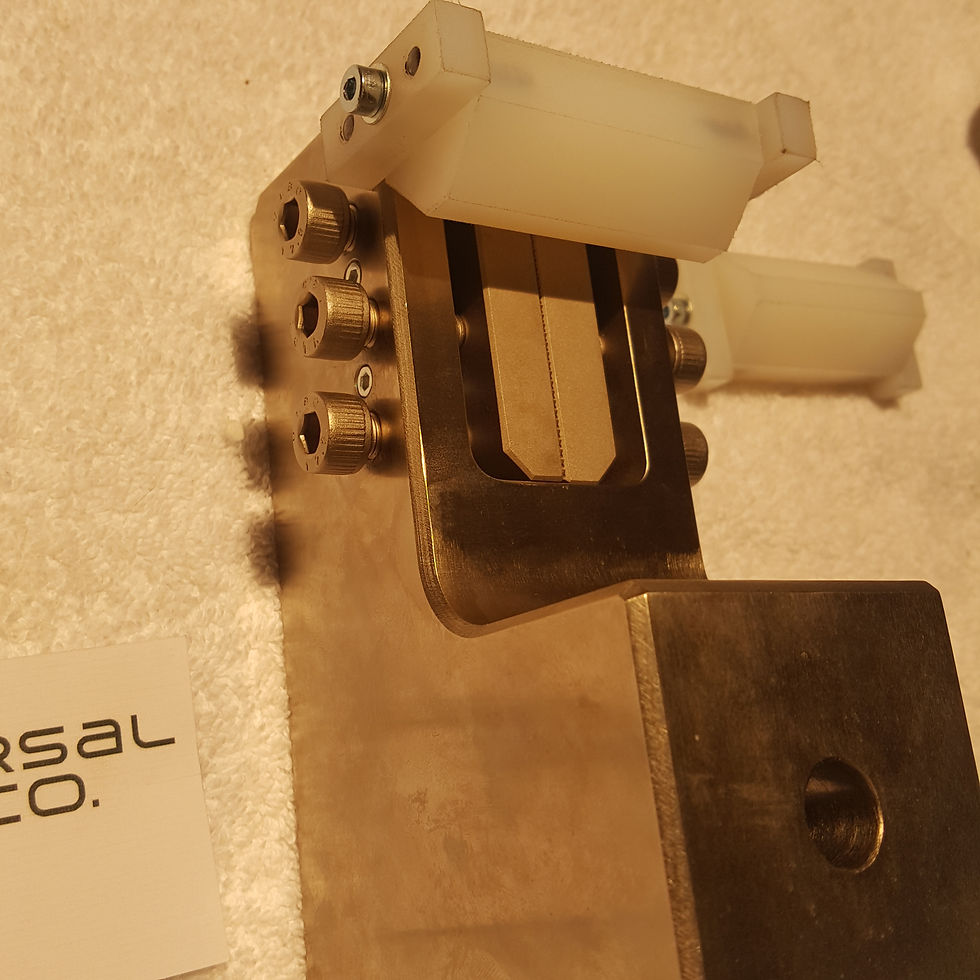
How to choose: start with D5379 for unidirectional tape and fine fabrics. Move to D7078 if your specimens crush at the loading points, twist, or the weave is too coarse for the small gauge section. On D7078, a sample alignment guide saves time and keeps specimens centered between the notches.
Interlaminar shear: ASTM D2344 short-beam fixture
ASTM D2344 is a three-point bend test on a very short beam, so the specimen fails in interlaminar shear before it can fail in bending. The span is 4 times the specimen thickness, the specimen is 6 times the thickness long and 2 times the thickness wide, and the standard calls for a 6 mm loading nose on 3 mm supports. Short-beam strength is 0.75 × maximum load ÷ (width × thickness).

What to look for: an adjustable span with clear markings, so one fixture covers every thickness you test, and correctly sized nose and support diameters. Loads are small, so a low-capacity load cell gives better resolution. Keep in mind that D2344 gives an apparent strength. It is excellent for QC, cure checks and screening, but it is not a design allowable.
Compression: ASTM D6641 CLC, D3410 and D695
Compression is the hardest composite property to measure well, because thin laminates want to buckle and specimen ends want to crush. The ASTM D6641 combined loading compression (CLC) fixture solves both by clamping the specimen ends between blocks so load goes in through shear and end loading together. The typical specimen is 140 mm long and 13 mm wide with a short 13 mm unsupported gauge section. Many laminates can be tested untabbed. High-strength unidirectional material needs tabs. The fixture runs between standard compression platens on any universal testing machine.

ASTM D3410 loads the specimen purely in shear through wedge grips. It works, but the fixture is heavier and more expensive, and CLC typically gives comparable results with less scatter. ASTM D695 is written for rigid plastics. Its anti-buckling jig is useful for thin plastic specimens, but for high-strength composites D6641 is usually the better choice.

Notched strength: open-hole tension and compression
Aircraft and automotive structures are full of fastener holes, so designers need strength with a hole in it. ASTM D5766 open-hole tension uses a 36 mm wide laminate with a 6 mm center hole, gripped in the same wedge grips as D3039. Only failures through the hole are valid. ASTM D6484 open-hole compression uses the same specimen width and hole, held in a support fixture with anti-buckling plates and side guides.

Buying checklist
Frame capacity and alignment: carbon laminates in D3039, D7078 and D6641 can need tens of kN, and poor alignment shows up as bending and early failures. Make sure your universal testing machine has the capacity and stiffness for your strongest material.
Adapters: confirm the fixture couples to your machine. We design and machine custom adapters to fit your frame.
Strain measurement plan: decide between strain gauges, clip-on extensometers and a video extensometer before you order fixtures, so they leave room for it.
Throughput: sample guides, quick-change jaw faces and spare rollers keep a busy lab moving.
Sandwich panels too? Add ASTM C393 flexure and ASTM C273 core shear fixtures.
Starter kits by lab type
Production QC: D3039 wedge grips, D2344 short-beam fixture, D6641 CLC fixture.
Material qualification and allowables: everything above plus D5379 or D7078 shear, D5766 and D6484 open-hole fixtures, and a video extensometer.
University and R&D: D3039 grips, D5379 shear and D2344 short-beam cover most coursework and research on a modest budget.
Get a complete composites fixture quote
Universal Grip designs and machines test fixtures and custom adapters. Send us your standards, laminate type, thickness range and machine model, and we will put together one quote for the grips, fixtures, adapters and strain measurement you need, or a complete system with a universal testing machine. Browse our shear fixtures or contact us for a quote.


Comments