
Tensile Grip & Fixture Selection Guide

Most labs don't buy grips from the company that built their test frame. They need tensile grips and fixtures that fit the machine they already own, whether that's an Instron, MTS, Shimadzu, ZwickRoell, Tinius Olsen or Mark-10 frame. This guide walks through how to pick the right grip or fixture and how to make sure it connects to your machine the first time. Universal Grip builds tensile grips, fixtures and adapters for all of these frames.

Step 1: Identify Your Machine Connection
Before you look at jaw faces or capacities, confirm how grips attach to your frame. Getting this wrong is the most common reason a new grip sits on a shelf. Most frames use one of three styles:
Clevis pin couplings: a round shank slides into a coupling and is held by a cross pin. This is the most common style on Instron and many other electromechanical frames.
Threaded connections: the grip screws onto a threaded stud or into a threaded hole on the load cell or base. Common on Mark-10 test stands and on many older or high-capacity frames.
Bolted or flange mounts: larger grips, especially hydraulic grips, are often bolted to the crosshead or actuator.
Measure the coupling or shank diameter, the pin diameter, or the thread size and pitch, and note your frame model and load cell capacity. If you aren't sure, send us a photo and those numbers and we'll confirm the fit.

Our three most common adapters cover most frames. Read Our 3 Most Common Grip Adapters for drawings and dimensions, or see all grip adapters.
Step 2: Choose the Grip Type for Your Material
Once the connection is settled, the material and standard decide the grip. For a deeper comparison, see How to Choose the Right Grips for Tensile Testing.
Wedge grips
Wedge grips tighten as load increases, so they hold metals, rigid plastics and composites without slipping. They are the most common replacement for OEM grips and come in capacities from a few kN to several hundred kN, with flat and V-groove faces.

Pneumatic grips
Pneumatic grips close with regulated air pressure, so clamping force is the same on every test. They are fast and repeatable for films, thin plastics, rubber, textiles, paper and wire, and foot pedal controls keep both hands free.

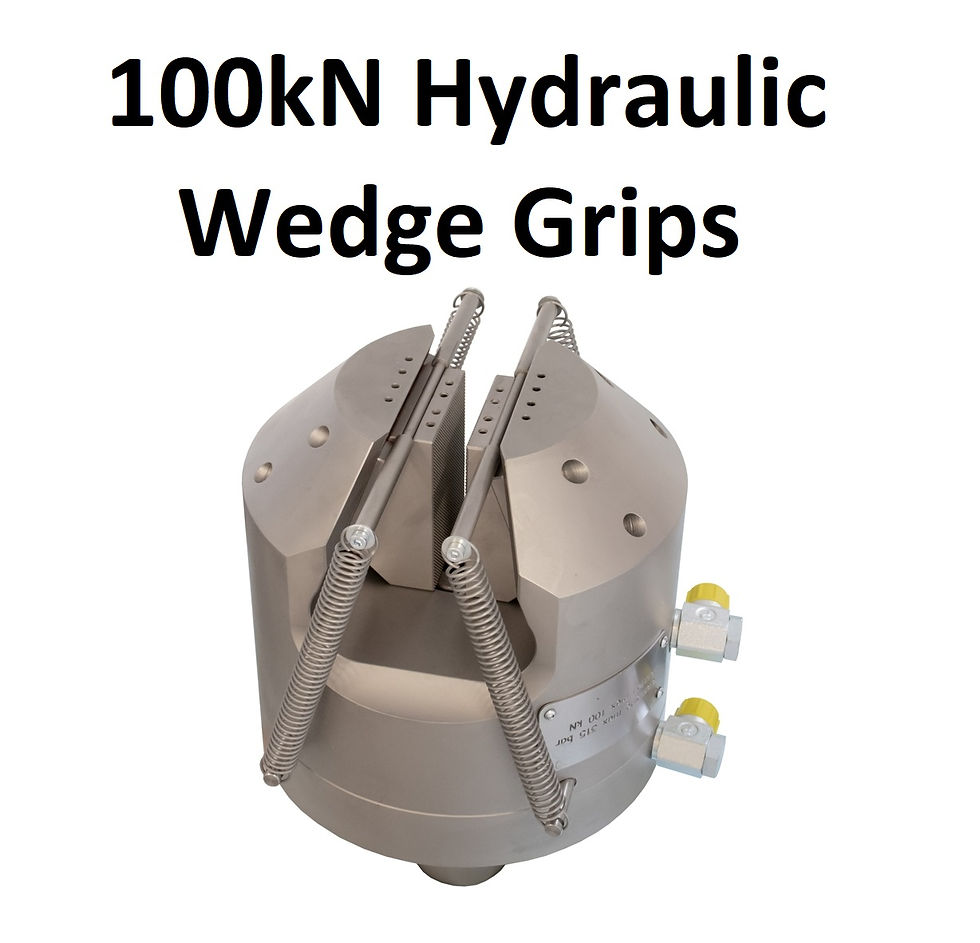
Hydraulic grips
Hydraulic grips apply a set clamping pressure before the test starts. They suit high-capacity work such as rebar, bolts, high-strength steel and thick composites on large floor-standing frames.
Vise, roller and specialty grips
Vise grips are simple and low cost for low to medium loads. Roller grips tighten as rubber and elastomer specimens thin. Rope, bollard and wrap grips handle cord, yarn and webbing, and pinch grips cover small parts and pull-off tests.
Grips for Popular Testing Machine Brands
The sections below cover what to check for each brand. In every case we can build the grip with the right connection or supply an adapter, so you keep using your frame, software and load cells.
Instron Compatible Grips and Instron Wedge Grips
Instron frames typically use clevis pin couplings, with the coupling size stepping up with frame capacity. Smaller benchtop frames often use a 12 mm coupling with a 6 mm pin, and larger frames commonly use a 31.7 mm (1.25 in) coupling with a 12.7 mm (0.5 in) pin. Our standard grips use a 15.8 mm shank with an 8 mm pin, and our adapters bridge between these sizes.
Instron wedge grips: our mechanical and hydraulic wedge grips are a common replacement or second set for metals and composites.
Pneumatic grips: for plastics, films and rubber on 5 kN to 50 kN frames.
Fixtures: bend, compression, peel and shear fixtures built with matching couplings.
MTS Grips
MTS electromechanical and servo-hydraulic frames use a range of threaded and pinned connections depending on model and age, and large MTS frames often share the 31.7 mm coupling with a 12.7 mm pin. For servo-hydraulic fatigue frames, tell us the actuator and load cell thread so we can supply fatigue grips or a threaded adapter that keeps the load train stiff and aligned.
Shimadzu Grips
Shimadzu AGS and AG series frames use pinned couplings that vary by frame capacity. Send us the coupling diameter and pin size, or the part number of the grip you have now, and we will match it with a direct-fit grip or an adapter.
Zwick Grips (ZwickRoell)
ZwickRoell frames use their own pin connection types, which differ by capacity. We build wedge, pneumatic, vise and specialty grips with a ZwickRoell-style connection or provide an adapter to our standard shank. Measure the coupling and pin, or send the grip type designation from your current grips.
Tinius Olsen Grips
Tinius Olsen benchtop and floor-standing frames use pinned and threaded connections depending on model. Older frames are common in QC labs, so a photo of the crosshead connection and a few measurements is usually the fastest way for us to confirm fit.
Mark-10 Grips
Mark-10 force gauges and test stands use threaded connections, typically #10-32 on lower-capacity gauges and 5/16-18 on higher-capacity models. Our motorized tensile testers and manual tensile tester use the same style, and we supply grips, pinch grips and fixtures with these threads. For a comparison of the two kinds of equipment, read Mark-10 Test Frame vs Universal Testing Machine.

Step 3: Match Fixtures to the Standard
Many tests need a fixture rather than a grip. Each of our ASTM fixture pages lists the standard's setup, so you can check specimen size, spans and capacity before you order. Common examples:
Tensile: ASTM D638 plastics, ASTM E8 metals, ASTM D412 rubber.
Flexural: ASTM D790, ASTM D7264 composites and the bend fixture range.
Compression: compression platens, ASTM D695 and ASTM D3410.
Adhesives and peel: ASTM D1002 and ASTM D5868 lap shear, and the peel fixtures.
What to Send Us for a Quote
Machine make and model, plus load cell capacity.
Connection details: coupling and pin diameter, or thread size, or a photo with a ruler.
Material and the test standard you run.
Specimen width, thickness or diameter, and maximum expected force.
Any temperature range if you test in an environmental chamber.
Contact us with these details and we will recommend a grip or fixture and confirm it fits your frame before you order.
Tensile Grip FAQ
Will your grips fit my Instron? Yes. We build grips with Instron-style clevis couplings and supply adapters between coupling sizes, so they fit most Instron frames.
Do I need an adapter? Only if your machine's connection differs from the grip's. We can build the grip with your connection or add an adapter, whichever is simpler and keeps the load train short.
Can I use the same grips on two different machines? Often, yes. With the right pair of adapters, one set of grips can move between frames of similar capacity.
Do you make fixtures as well as grips? Yes. We build bend, compression, shear, peel, puncture and standard-specific fixtures, all with the connection your machine needs.
Instron, MTS, Shimadzu, ZwickRoell, Tinius Olsen and Mark-10 are trademarks of their respective owners. Universal Grip is an independent manufacturer and is not affiliated with these companies; brand names are used only to describe compatibility.


Comments