
Video Extensometer Retrofit: Add Non-Contact Strain Measurement to Your Instron, MTS or Shimadzu Machine
Most testing labs don't have a load frame problem. The frame is accurate, the load cell is calibrated, and the controller works fine. What holds them back is strain measurement: a drawer full of clip-on extensometers for different gauge lengths, knife edges that slip on hard metals or cut into soft plastics, and extensometers that have to come off before the specimen breaks. You can fix that without replacing the machine. A video extensometer mounts in front of the frame you already own and feeds strain to its controller like any other extensometer. It's also a common way to replace an aging or expensive OEM extensometer.
What is a video extensometer?
A video extensometer is a non-contact strain measurement system. A camera watches marks or a speckle pattern on the specimen during a tensile, compression or flexure test, and software tracks how far apart they move using digital image correlation at sub-pixel resolution. Because nothing touches the specimen, it adds no force, can't slip, and can stay on through fracture. Good systems are rated to ISO 9513 Class 0.5 and ASTM E83 Class B-1, the accuracy levels most metals, plastics and composites standards ask for.
Why choose a video extensometer? 5 signs your lab is ready
You own two or more clip-ons. Once a lab needs several gauge lengths, one video extensometer with a software-set gauge length starts to cost less than the clip-ons it replaces.
You remove the extensometer before break. Non-contact measurement stays on through fracture, so you capture elongation at break without risking the instrument.
Your specimens are thin, soft or delicate. Films, coatings, elastomers and fibers can be damaged or loaded by knife edges. A camera puts no force on the sample, and elastomers that stretch 300 to 700% stay in view.
You need transverse strain. Poisson's ratio and r-value need width change as well as length change, which a single clip-on can't give you.
You test hot or cold. A video extensometer measures through the window of an environmental chamber, so nothing has to survive the temperature inside.

Clip-ons still have their place. They are simple for repetitive, standardized work and don't depend on lighting or surface contrast. If none of the points above apply to you, a good clip-on may be all you need. This side-by-side shows the difference:
How a video extensometer retrofit works
The system is a camera, an LED light source and software. The camera sits on a mount in front of the frame, and the software sends strain to your machine's controller. Your existing testing software sees it as a normal extensometer channel, so your methods, reports and calculations stay the same.

The key question is how the signal gets into your controller. The Vector U70, U200 and B80 each have a ±10 V analog output on a BNC connector plus an RS-232 serial output. The XSight ONE series supports analog, RS-232, TCP/IP, MODBUS, DOLI and pulse encoder connections. If your machine has an extensometer input, we handle the cabling, signal conversion and plug to match it, including on older frames. That also makes closed-loop strain control possible on controllers that support it, which matters for strain-rate controlled tests such as ASTM E8 and ISO 6892-1.
Compatible with Instron, MTS, Shimadzu, Zwick and Tinius Olsen
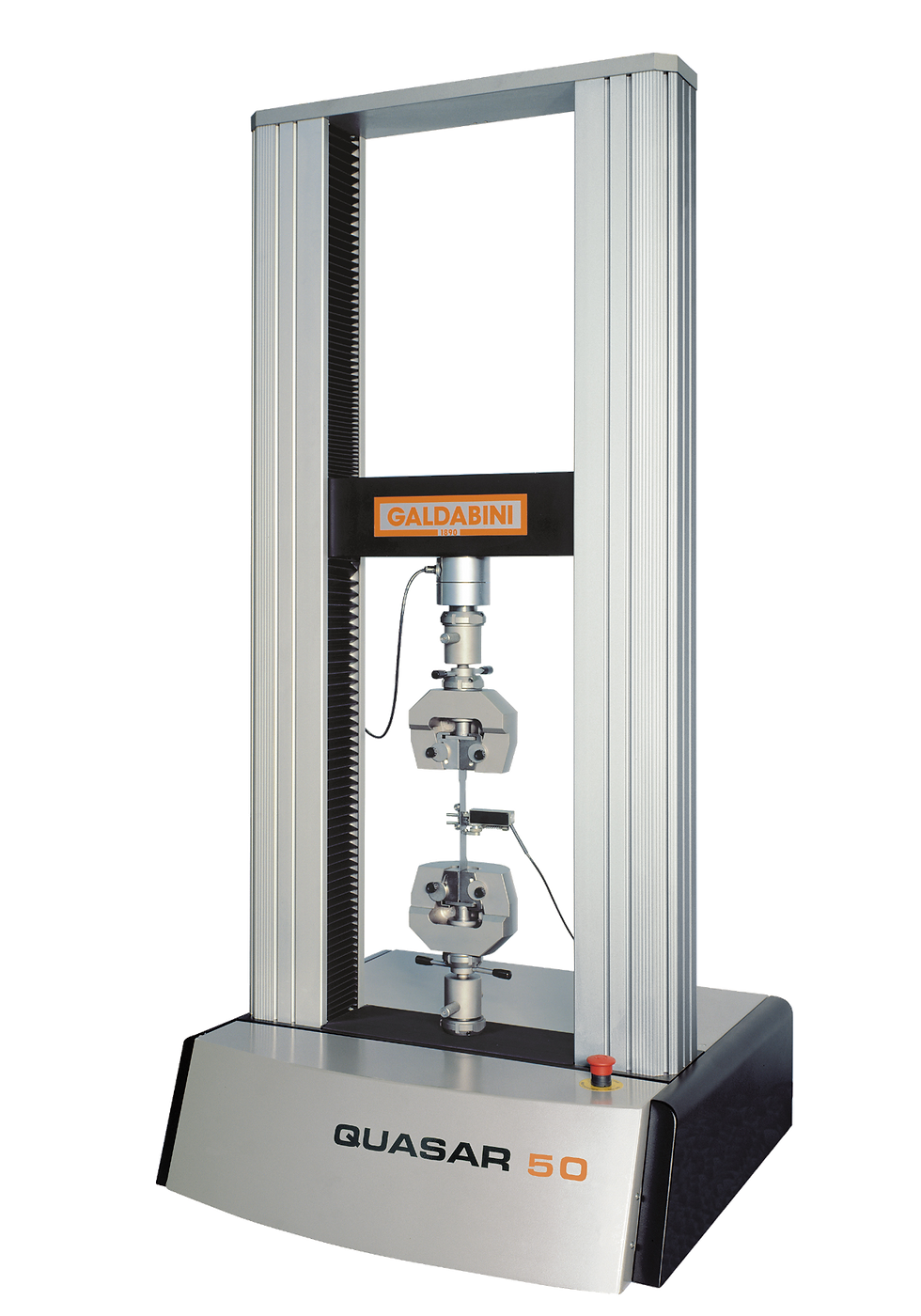
We integrate video extensometers with Instron, MTS, Shimadzu, Zwick/Roell, Tinius Olsen and Galdabini machines. Before you request a quote, have this ready: the machine make and model, the controller model, the testing software and version, and whether the controller has a free extensometer input. If it doesn't, the extensometer can also run standalone for R&D work.
Video extensometers by material and standard
Plastics: ASTM D638 and ISO 527, typically 25 to 50 mm gauge length. Modulus needs strain on the specimen, and soft plastics benefit from zero contact force.
Composites: ASTM D3039, typically 25 to 50 mm, with axial and transverse strain at once for Poisson's ratio.
Rubber and elastomers: ASTM D412, typically 25 to 100 mm, where elongation can pass several hundred percent. A wide field of view keeps the marks in frame.
Metals: ASTM E8 and ISO 6892-1, typically 50 mm (2 in), with strain-rate control and measurement through to fracture.
High and low temperature: measurement through a chamber window, with nothing inside the chamber to protect.
Choosing the right model
Pick a system that covers your shortest and longest gauge length at the accuracy class you need, then decide how much setup work you want your operators to do.
XSight ONE M1 (2D): 80 mm field of view, gauge lengths up to 80 mm at ISO 9513 Class 0.5. Metals and wire.
XSight ONE M2 (2D): 110 mm at Class 0.5, 190 mm at Class 1. Plastics, composites and general use.
XSight ONE M16 (2D): 330 mm at Class 0.5, 660 mm at Class 1. Rubber and large displacements.
Vector U70 (3D): 10 to 50 mm gauge length on specimens as narrow as 2 mm, ISO 9513 Class 0.5 and ASTM E83 Class B-1, 150 Hz.
Vector U200 (3D): 25 to 180 mm gauge length, same accuracy class and data rate.
Vector B80 (3D biaxial): 7.5 to 70 mm axial and 6 to 25 mm transverse at the same time, for Poisson's ratio and r-value.
2D systems are the most economical but need a well-focused, flat, evenly lit specimen. 3D systems cost a little more, and their onboard NVIDIA GPU compensates automatically for focus, lighting and out-of-plane movement, which cuts operator setup time.

Setting it up on your frame
Mount the camera square to the specimen at its working distance: about 280 to 320 mm for the U70 or 300 to 500 mm for the ONE series.
Set the lighting with the included LED illumination. A polarizing filter helps on shiny metal surfaces.
Calibrate by placing the calibration plate at the working distance. The software calibrates the pixel grid automatically.
Mark your specimens with high-contrast marks inside the gauge section: black on light samples, white on dark, blue on gray or metallic. Use two dots or lines for routine tensile tests, add marks across the width for transverse strain, or use a random speckle for full-field strain. Our gauge length marking tool punches 2 or 4 mm dots of 3M retro-reflective tape at 10, 20, 25 or 50 mm (or 1/2, 1 and 2 in) spacing.
Set the gauge length in software to match your standard, entirely within the reduced section. See our guide to gauge length selection across ASTM standards.
Map the output to your controller's extensometer channel and run a check specimen against a known result before going live.
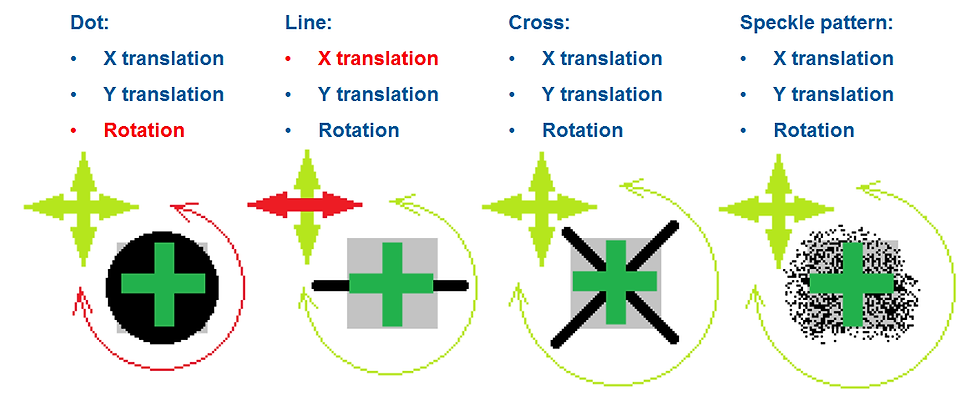
Marking is where most first-time users lose accuracy: low contrast, ink that flakes, marks outside the gauge section, or a perfectly regular grid that confuses the tracking software. Watch our marking guide below, or read the complete guide to sample marking for what works on metals, plastics and rubber.

Video extensometer cost and what it replaces
Our video extensometers start at $14,999. Compare that with buying a new testing machine, or with the three to five clip-on extensometers many labs keep for different gauge lengths, plus their knife edges, recalibration and repair. A video extensometer has no moving parts to wear out, and the same unit covers metals, plastics, composites and elastomers. If you're weighing the two technologies, read video extensometers vs. clip-on extensometers and when should you use an extensometer? To take the risk out of the decision, we offer a 30-day try and buy program, so you can run it on your own frame with your own specimens before you commit.
Video extensometer FAQ
Can I add a video extensometer to my Instron or MTS machine?
Yes. If the controller has an extensometer input, we configure the analog or digital signal and connector to match it. The same applies to Shimadzu, Zwick/Roell, Tinius Olsen and Galdabini frames, including older models.
How accurate is a video extensometer?
Our Vector models are rated to meet ISO 9513 Class 0.5 and ASTM E83 Class B-1. The XSight ONE series supports ISO 9513 Class 0.5 and Class 1, depending on the field of view you use.
Do I have to mark my specimens?
Yes. The camera tracks high-contrast dots, lines or a speckle pattern. With a marking pen or our marking tool, it takes a few seconds per specimen.
Can a video extensometer measure to break?
Yes. Nothing touches the specimen, so there is nothing to remove or damage at fracture.
Does it work inside an environmental chamber?
Yes. It measures through the chamber window, so no part of the extensometer is exposed to the temperature inside.
How much does a video extensometer cost?
Our systems start at $14,999, and you can try one on your own machine for 30 days before you buy.
Get a retrofit quote
Send us your machine make and model, controller, testing software, the standards you run and your specimen types. We'll recommend the right extensometer, confirm the signal connection to your controller, and quote the complete package. Start on our video extensometers page, compare all our extensometers, or contact us. Shopping for a new frame instead? See our universal testing machines. More demos are on our YouTube channel.


Comments