
Aerospace Composite Testing: Carbon Fiber Shear Fixtures, Galdabini UTMs and ASTM Methods for the Space Boom

Aerospace and space programs are some of the busiest customers in our shop right now. Launch providers, satellite builders, drone and eVTOL developers, tier-one aerostructure suppliers and the independent labs that qualify their materials are all running more carbon fiber coupons than ever, and every one of those coupons needs a fixture that holds geometry to the tolerances the ASTM method demands. This post walks through the aerospace work we are doing at Universal Grip Company: the carbon fiber shear and compression fixtures we machine in-house, the Galdabini universal testing machines we pair them with, and the video extensometers, temperature chambers and custom high-temperature grips that turn a fixture into a complete qualification test system.
If you are building out a composites lab or adding capacity for a new program, jump to the section you need, or contact our team for pricing and lead times.
The space industry is booming, and composites are carrying the load
The numbers behind the space boom are hard to ignore. The Space Foundation's The Space Report put the global space economy at a record $613 billion in 2024, and McKinsey projects the space economy will reach $1.8 trillion by 2035, growing at roughly twice the rate of global GDP. Launch cadence tells the same story: BryceTech counted 325 orbital launches in 2025, about 25% more than the year before, which put 4,544 spacecraft into orbit, up roughly 54%.
Nearly every one of those vehicles is lighter because of carbon fiber. Composite overwrapped pressure vessels, interstage and fairing structures, satellite bus panels, solar array substrates, honeycomb sandwich decks, drone airframes and aircraft primary structure all depend on polymer matrix composites, and every new material system, layup or supplier has to be characterized coupon by coupon before it flies. That coupon testing is the foundation of the aerospace building-block approach used for design allowables and certification, and it is exactly where our fixtures and testing machines live.
What we are seeing from customers:
New space and launch companies standing up in-house composites labs instead of waiting weeks on outside test houses.
Tier-one and tier-two aerostructure suppliers adding test stations to qualify new prepregs, out-of-autoclave resins and thermoplastic composites.
Independent and university labs expanding capacity for qualification and equivalency programs, often running the same methods at room temperature, hot/wet and cold.
Defense, drone and eVTOL programs that need a complete, turnkey composite test cell delivered quickly.
Carbon fiber shear fixtures for aerospace composites
Shear is where carbon fiber laminates are weakest and hardest to measure, so it is where fixture quality matters most. Our shear fixtures are machined in our own shop, hold tight alignment between the loading halves, and ship ready to mount on Galdabini or any other universal testing machine with standard adapters.
ASTM D5379 Iosipescu V-notched beam shear fixture
The ASTM D5379 Iosipescu shear fixture loads a double V-notched beam so that a nearly uniform shear stress develops across the notch root. It measures in-plane and interlaminar shear strength and, with strain measurement across the notch, shear modulus. Our fixture keeps the upper and lower loading arms at fixed spacing and alignment and uses spherical seating to minimize unintended bending. The standard specimen is roughly 76 mm × 20 mm × 3 mm with two 90° notches.

ASTM D7078 V-notched rail shear fixture
The ASTM D7078 V-notched rail shear fixture clamps the specimen along its edges with gripping rails instead of loading the edges directly. It is the go-to choice for tougher, thicker or more flexible laminates that can crush at the loading points in a D5379 test, and the larger gauge section gives more room for strain measurement.
ASTM D2344 short-beam shear fixture
The ASTM D2344 short-beam strength fixture uses a three-roller setup at a 4:1 span-to-thickness ratio to drive an interlaminar shear failure. It is the quickest screening test for porosity, fiber-matrix adhesion and cure quality, which is why it shows up on almost every incoming-material and process-control plan.
Sandwich and core shear: ASTM C273
Honeycomb and foam-core sandwich panels are everywhere in spacecraft and aircraft interiors. The ASTM C273 core shear fixture measures shear strength and modulus of the core and its bonds, and it pairs with ASTM C297 flatwise tension, ASTM C393 sandwich beam flexure and ASTM D7249 long-beam flexure for a full sandwich characterization package.
Compression, open-hole and damage-tolerance fixtures
ASTM D6641 combined loading compression (CLC) fixture
The ASTM D6641 CLC fixture introduces load through a combination of end loading and shear loading from serrated, torque-clamped jaws, which lets you test untabbed carbon fiber laminates in compression without crushing the ends. It runs between a pair of compression platens, and our Galdabini 50 kN and 100 kN machines can ship preloaded with the D6641 procedure.
For compressive properties of rigid plastics and some composites, we also offer the ASTM D695 compression fixture and a full line of compression fixtures.
Open-hole tension and compression: ASTM D5766 and D6484
Fastener holes are unavoidable in real structures, so notched strength drives design allowables. The ASTM D5766 open-hole tension fixture measures how a central hole knocks down laminate tensile strength, and the ASTM D6484 open-hole compression fixture supports the specimen against buckling so the failure happens at the hole, not as global instability.
Compression after impact: ASTM D7137
Damage tolerance is a core aerospace requirement. The ASTM D7137 compression-after-impact fixture uses anti-buckling side rails and end-loading platens to measure the residual compressive strength of a laminate after a controlled impact, while leaving room for local out-of-plane deformation at the damage site.
Composite tensile testing: ASTM D3039
ASTM D3039 is the baseline tensile test for polymer matrix composites, run on tabbed or untabbed strips in aligned wedge grips or hydraulic grips. The same setup, combined with a biaxial video extensometer, also covers ±45° in-plane shear response under ASTM D3518.
More aerospace test methods we support
Beyond the fixtures above, aerospace and space customers use our equipment for a long list of related methods. A partial list:
ASTM D3518: in-plane shear response by tensile test of a ±45° laminate, using D3039-style grips and a biaxial video extensometer.
ASTM D7264 and ASTM D790: flexural properties of composites and plastics, using our bend testing fixtures.
ASTM C1341: flexural properties of continuous fiber-reinforced ceramic matrix composites, the materials used in hot sections and thermal protection.
ASTM C1161: flexural strength of advanced ceramics.
ASTM D1781 climbing drum peel and ASTM D3167 floating roller peel: bond strength of structural adhesives and sandwich facings, two staples of aerospace adhesive qualification.
ASTM D1002: lap shear strength of adhesively bonded metal specimens.
ASTM B769 and ASTM B565: shear testing of aluminum alloys and rivet wire, common for aerospace aluminum.
ASTM E8: tensile testing of metallic materials, including aerospace alloys.
Bearing, fastener pull-through and custom coupons: because we are a machine shop, we regularly build custom fixtures to a customer's drawing or internal spec. Tell us what you need.
Galdabini universal testing machines: programmable and customizable for aerospace
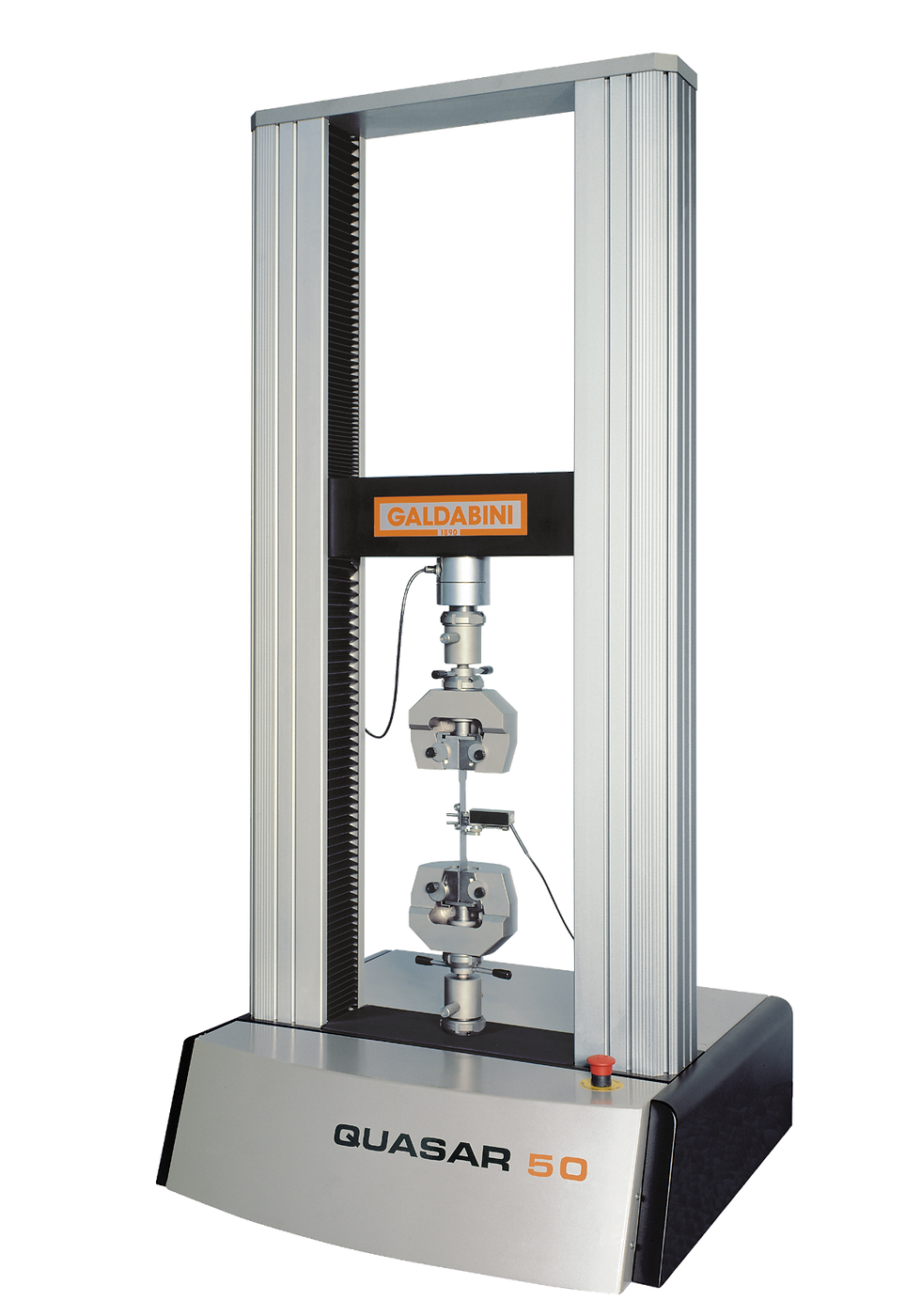
Universal Grip Company is the exclusive U.S. distributor of floor-standing and large-format Galdabini universal testing machines. Galdabini has been building testing equipment in Italy since 1890, and its machines are a strong fit for aerospace labs because they are highly programmable and customizable instead of being locked into a fixed menu of tests.
Programmable test procedures: Galdabini develops its control and analysis software in-house, so test sequences can be built around the exact control modes, rates, hold points and calculations a method calls for. Machines can ship preloaded with the procedure for your method, such as ASTM D6641, so a new lab is testing on day one, and new methods can be added as your test matrix grows.
Open architecture: a Beckhoff PLC with embedded industrial PCs ties the subsystems together, the machines are not locked by passwords, and electronic components can be replaced on site. Galdabini can also diagnose issues remotely.
Precision drive and frame: dual-column frames with Bosch Rexroth ball screws give the stiffness and alignment that shear and compression tests depend on.
Customizable to the lab: modular design accepts our grips and fixtures, environmental chambers and video extensometers, and frames are built for calibration to ASTM E4 and ISO 17025.
The full capacity range: benchtop machines from 2.5 kN through 5 kN, 10 kN, 25 kN, 50 kN and 100 kN for coupon work, floor-standing machines at 200 kN, 250 kN, 600 kN, 1000 kN, 1200 kN and 2000 kN for thick laminates, aerospace alloys and structural elements, plus hydraulic machines.
We handle installation, calibration, training and ongoing support, so a program team gets one point of contact for the machine, the fixtures and the strain measurement.
Video extensometers for composite strain measurement
Composite methods need accurate strain, not just load. Modulus, Poisson's ratio and shear modulus all depend on it, and bonding strain gauges to every coupon is slow and expensive. Our Universal Video Extensometer (UVE) is a non-contact, digital image correlation (DIC) system that measures strain directly from the specimen surface.
2D ONE series (M1, M2, M5, M9 and M16) covers gauge lengths from 80 mm to 330 mm for D3039 modulus and general tensile work.
3D Vector series: the U70 and U200 for metals, composites and plastics, and the B80 biaxial model for Poisson's ratio and the axial-plus-transverse strain needed for D3518 and shear-modulus calculations on D5379 and D7078 coupons.
No contact, no knife edges: nothing slips or damages the specimen at failure, and full-field strain maps show exactly where a laminate is failing.
Works with most machines, including Galdabini, Instron, MTS, Tinius Olsen, Shimadzu and ZwickRoell, and can look through a chamber window for hot and cold testing.
Pricing starts at $14,999 with a 30-day try-and-buy program.
Accurate gauge marks make video strain measurement faster and more repeatable. Our gauge length marking tool puts consistent marks on every coupon.
Temperature chambers for hot, cold and cryogenic composite testing
Aerospace allowables are rarely room-temperature only. Resin-dominated properties such as compression, short-beam shear and in-plane shear drop off at elevated temperature, especially after moisture conditioning, and launch and space hardware has to perform at cryogenic temperatures. Our environmental chambers bring that range to the test frame:
-70°C to 280°C standard, with up to 350°C available and custom temperature ranges and chamber dimensions on request.
Liquid nitrogen cooling for fast, deep cold, plus refrigerated and chiller-based options for long tests at moderate cold.
RTD temperature control and heated windows that prevent fogging, so a video extensometer can measure strain through the glass.
Available on Galdabini dual-column machines, with a retrofit kit for most existing dual-column universal testing machines and fixed, sliding-rail or wheeled-sled mounting.

Custom high-temperature grips and fixtures
Putting a chamber on a frame is only half the job: the grips and fixtures inside it have to survive the heat and stay aligned. Above about 150°C, standard grips are not enough, so we machine heat-treated, nickel-plated grips and fixtures built to hold up in hot oven conditions without galling or losing clamping force.
Built to fit the chamber: internal space is limited, so we size grip bodies, pull rods and adapters to the chamber you have.
Composite fixtures at temperature: D5379, D7078, D6641, D2344 and open-hole fixtures can be built in high-temperature versions on request for hot/wet and elevated-temperature allowables.
Pneumatic grips in the chamber: pneumatic grips can run inside the chamber with heat-resistant, jacketed air hose, since standard air lines can soften above about 70°C.
Built to your drawing: as a machine shop, we design and manufacture custom tensile grips, wedge grips and fixtures to a customer's spec when a catalog part will not do.
A complete aerospace composite test cell from one supplier
The labs that are moving fastest on new space and aerospace programs buy the whole system at once: a programmable Galdabini frame, the shear, compression and open-hole fixtures for their test matrix, a video extensometer, a temperature chamber and high-temperature grips, all set up, calibrated and trained on by one team. That is what we build at Universal Grip Company.
Ready to scope your lab? Contact us or call +1-978-882-1480 with your test matrix and we will recommend a frame, fixtures and accessories. You can also browse all of our ASTM test method pages, see more on our shear testing applications and compression testing applications pages, or watch more demos on our YouTube channel.


Comments